
How our family board gaming began
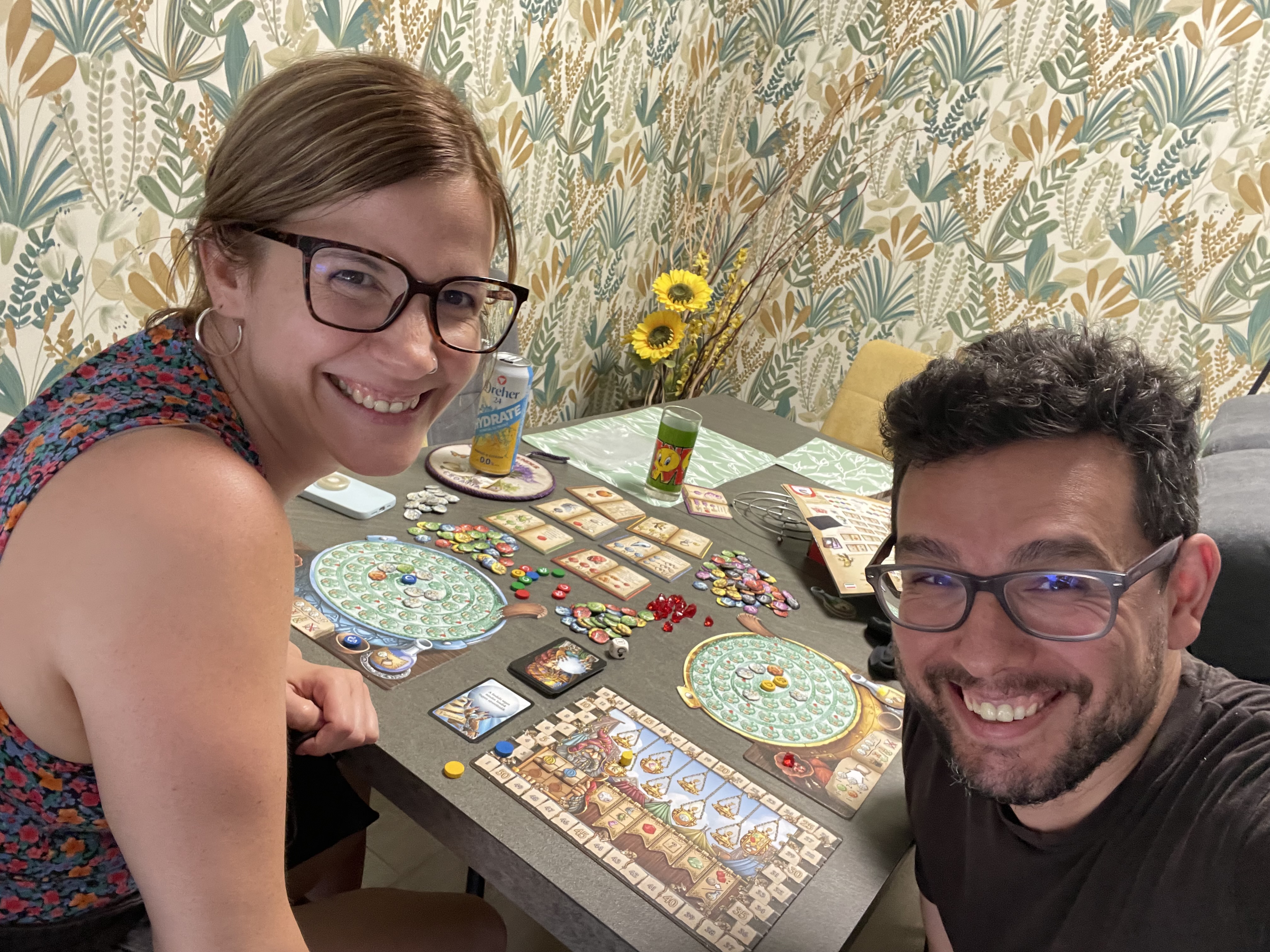
I started getting into modern board games as an adult, at the age of 27. As a child, we didn't play board games regularly; I too struggled with the classics like Hotel or Monopoly, which I would never recommend as family board games today. My cousins had Risk, I played chess and Nine Men's Morris from time to time, and later Activity, but it didn't seem like this would become my life.
It's a funny story that my wife is now also a big board gamer, but it certainly didn't start that way. We have a sweet story from before we even got together. I was spending New Year's Eve at our neighbors' with my previous partner, and my wife — who was just a good friend at the time — dropped by and saw us enthusiastically trading beans instead of partying at some club. Yes, we were playing Bohnanza, which from the outside, without knowing the game or the gaming subculture, must have seemed like quite a strange pastime. Today she sits on the same side of the table where we trade beans, instead of drinking until dawn.
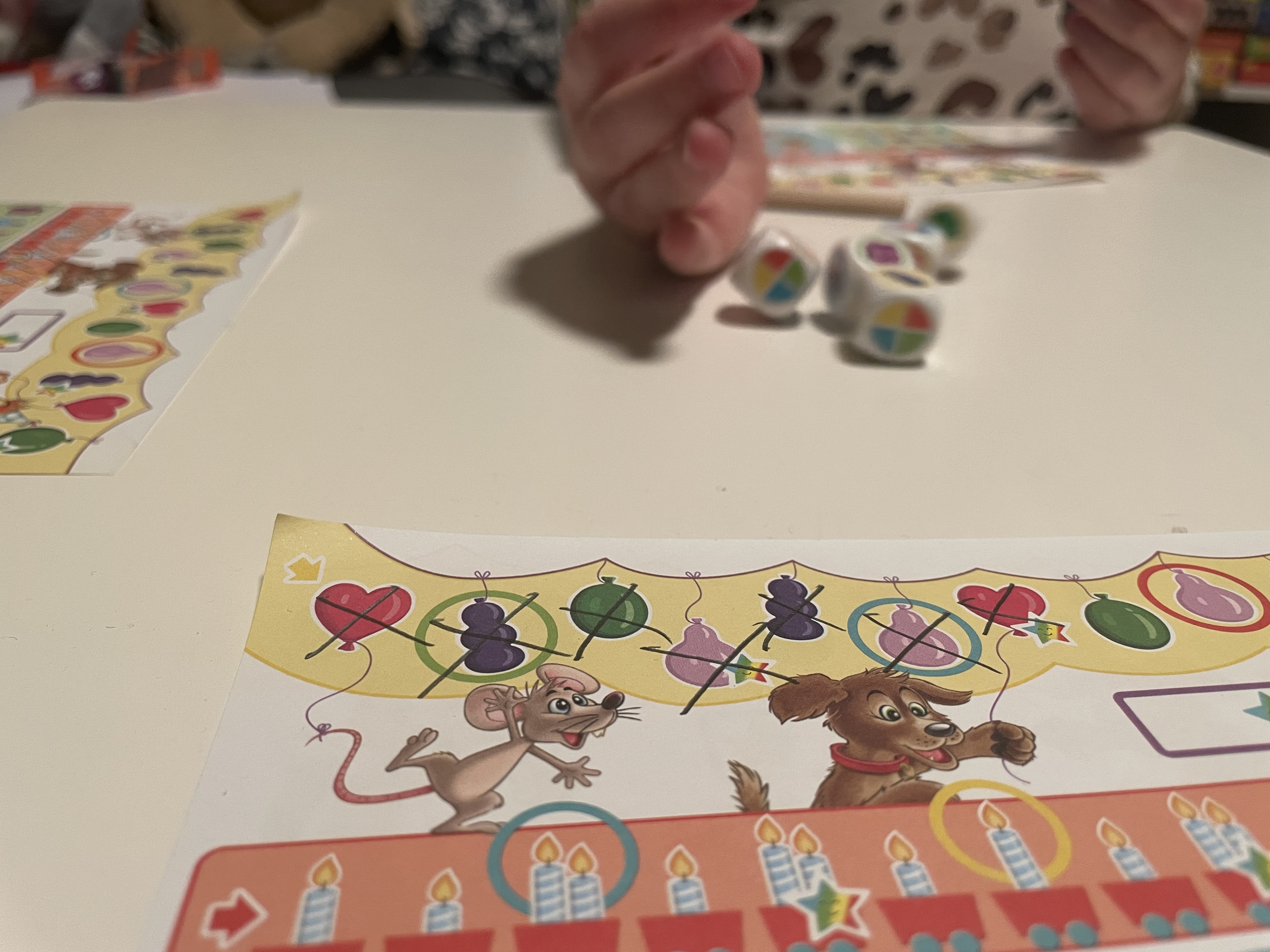
So it's no surprise that board gaming holds an important place in our children's lives too. Both of our daughters' first game was Hopp Hopp Haschen by Knizia — we even wrote a blog post about it. Both of them discovered the game at one and a half years old, though one did so seven and a half years ago and the other just a few weeks ago. We're at different points on the journey — the older one recently even beat me fair and square in another Knizia classic, Keltis - The Card Game. That road is quite long, but fortunately just as exciting.
The games we grew up with
I've already written on the PlayWise site about how fortunate we are to be living in the golden age of modern board games, with countless options and countless games to choose from. There are so many themes and mechanics available from as young as 2-3 years old, and there are countless great children's games that are also enjoyable for us adults — which is a very important consideration during family play.
Of course, there are many possible paths. I wrote about one in this article. Now let's see what games came up and in what order.
The beginnings (ages 2-4)
- Hopp Hopp Haschen – a cute luck-based dice game, great for learning colors, for example.
- Nanu? – a memory game twisted just enough to be enjoyable, but not too much.
- Little Action – a game for those who can't easily sit still at the table yet.
- Affenbande – a completely random game, yet its minimalism works for the youngest ones.
- The Little Orchard – a cooperative memory game for getting to know cooperative games.
- Speed Colors – turning coloring into a game is really cool, we're experimenting with it too.
The next stage (ages 4-6)
- Rhino Hero – the perfect meeting of Uno and building blocks.
- Outfoxed! – if we like cooperating, this is the best choice.
- Verflixxt! – if you don't believe a roll-and-move game can be creative and exciting, check this out!
- Da ist der Wurm drin – a simple roll-and-move racing game, except you can't see the race the whole time, and that's exactly what makes it truly unique and exciting.
- Piou Piou – the perfect card game for kids: funny, fast-paced, suspenseful, luck-based.
- Catan Junior – while you're waiting for Catan.
- Dragomino – while you're waiting for Kingdomino.
- Stone Age Junior – while you're waiting for Stone Age.
- Quacks & Co.: Quedlinburg Dash – while you're waiting for Quacks of Quedlinburg.
- Ganz Schön Clever Kids – while you're waiting for Ganz Schön Clever.
The golden age of board games
A benefit of the already mentioned golden age of board games is that it probably wouldn't be hard to create an equally good list from a different set of 16 games.
What do family games actually develop?
Let's start with: nothing. Seriously! As both a pedagogue and a parent, I feel enormous pressure toward direct development. That every moment, every activity should push the child forward in giant steps on the highway of competency development. Let's stop for a moment, slow down, look around, and just play! Let's take out our shared favorite board game, or find a new one together, and play! Let's not stress about it — the focus shouldn't only be on what it develops, what will make the child better, smarter, more skilled. Instead, the focus should be on what will make them happier, what will make us happier together. Let's enjoy ourselves, and surprisingly, the developmental elements will work well despite that. Perhaps even better!
Board game pedagogy requires an attitude where we are intentional in building our game collection, but spontaneous and joyful during play.”
Let the games do their work, let them have their effect!
We can say things like cooperative games teach cooperation, but in this article we've already described that board gaming itself is a cooperative activity. This means competitive games also teach a lot about cooperation, as well as about winning and losing. But most of all, they teach about how many different paths you can take in games, how you can try different strategies, ideas, and approaches — life unfortunately doesn't always offer this many opportunities, so it's good to have a tool that's perfect for experimenting. It's important not to focus solely on teaching frustration tolerance, because I've seen so many children who don't know how to win. And I don't mean celebrating disrespectfully on top of the table — I mean not experiencing their own outstanding performance.
I also see a great danger in our constant desire for smarter children, so we want to develop them with hard, "clever," logic games. Go is my favorite game, I play it a lot, I think it's important in a thousand ways, and while my enthusiasm led me to show it to my daughter, it's not what we play, it's not our family game — and not just because it's a two-player game. When I discovered the world of modern board games, what became important to me about their pedagogical impact was precisely that they can do so much that "clever" games cannot. They can be played with more people, requiring adaptation to more players; they include fun, and luck plays an important role. Developing through luck? Yes! On one hand, it levels the playing field, and it also demands constant flexibility from the player. You can make the best possible decision, you can build a safe, well-functioning system, but because of luck's twists, you have to be ready to react and rethink, reassess, and weigh options in unexpected situations. A good example of this is Quacks of Quedlinburg — or any good push-your-luck game — because no matter how good your bag is, no matter how smart you are, chance can bring it so that you barely score any points and have to make uncomfortable decisions. Sometimes ones you didn't even expect. And this is tremendous learning, especially because you encounter such situations in an extraordinary, protected environment, not in real life, fighting for real goals.
So what do family games actually develop? Family play. As I wrote above: rituals form, shared habits, rules. It's not just games that have rules — playing itself has rules too. Board games are rule-based play, the child needs to be ready for it — let's set aside the academic literature for now and instead observe that board games are being made for children as young as two and a half — but the family also needs to be ready. If we want board games to have an effect, to be quality, developmental time spent together, then we need to be present. Let's slow down, arrive, stop checking our phones for emails, and experience the shared play. And by doing this, we'll learn a great deal about the reality of life.
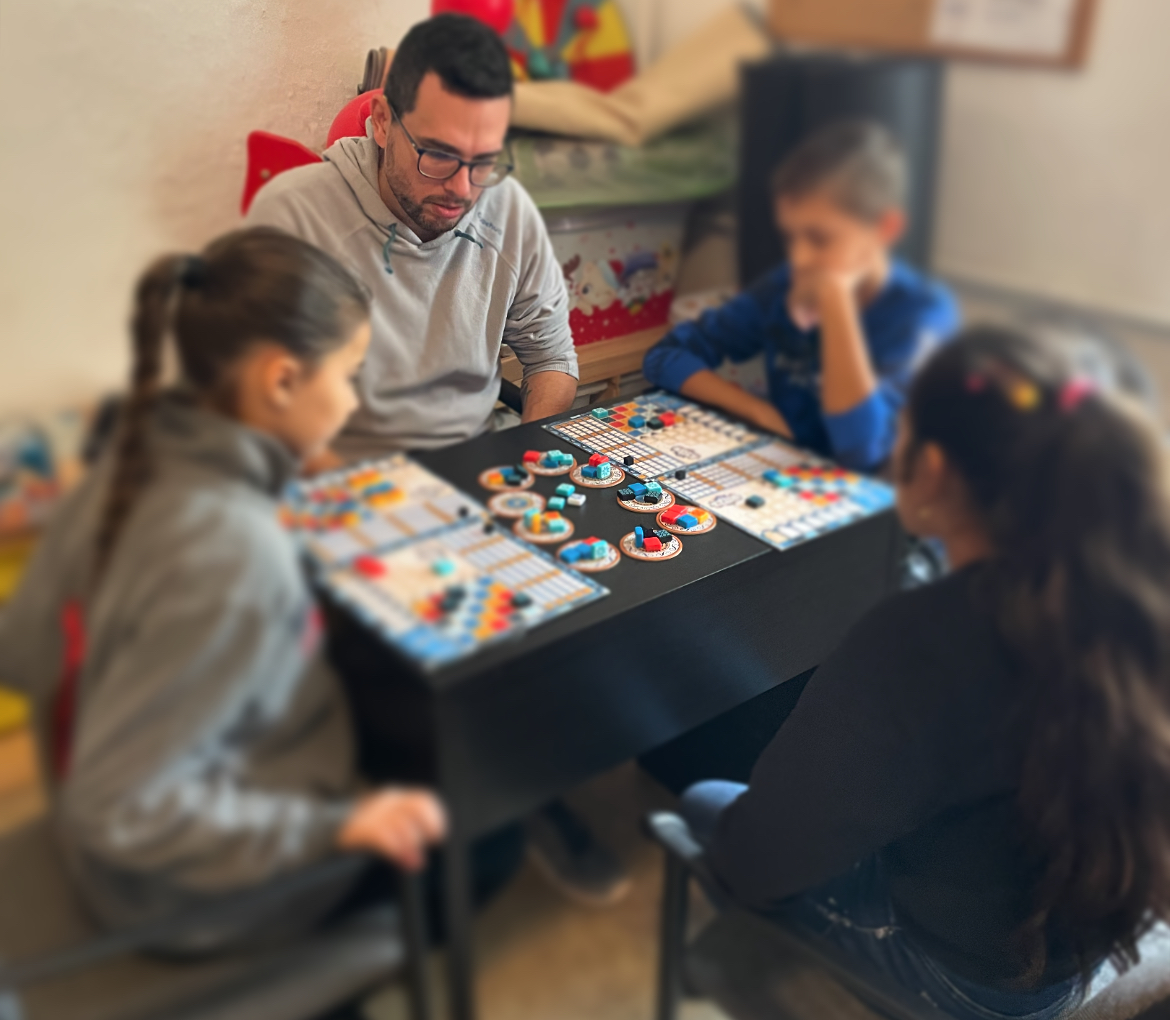
I know that sometimes it's very hard not to teach. Especially if you're a pedagogue, since you've been taught to teach for years. But there's plenty of pressure on us as parents too. I've experienced this on my own skin many times. I noticed that as a pedagogue, when there are a few steps of distance between me and the children, when the emotional involvement isn't as strong as with my own kids, it's easier for me to follow my own pedagogical principles. Letting a child make mistakes, struggle, be disappointed sometimes isn't always easy, yet they learn enormously from these situations.
At home, Kalaha is an important two-player game for us; everyone loves it and we gladly bring it out. It's typically the kind of game you could teach someone to play well — but why would you? Why take away the joy of discovery and learning from a child by teaching them the correct opening? We're not preparing for a competition, we're just playing. When my then 7-year-old daughter and I were learning the game, I managed to stay consciously present and held back from correcting her mistakes. I let her struggle, search, draw her own conclusions, and try the possible paths. And over time, she figured out the game on her own. Today she always beats me when she goes first, and now she's learning how to minimize the loss when she doesn't start. We play back-and-forth matches and whoever wins with more stones is the overall winner, since by now the starting player always wins, but in this comparison there's still room for growth. This example shows well that patience bears fruit and it's worth it, because she learned a tremendous amount throughout the process — about learning itself, about herself. She calculated and tried countless possibilities, made plans and discarded them. And all we did was drop pebbles into holes.
Age groups and game readiness
Family games are typically rated 8+, but as a game designer I know exactly how difficult and how many factors go into these age recommendations, many of which are marketing. I always say that the parent, the teacher knows the child best, and if this is paired with extensive game knowledge, then we'll always be able to find the right board game. A child who has been playing board games regularly with a variety of games since age 2-3 will arrive at 8+ games before turning eight. Not because they're smart, but because they're experienced — which at this age is still definitely built on strong motivation, which matters again, because a motivated child who wants to can be shown more challenging things, and will develop more easily and faster.
This doesn't mean it's a racing stable where we should teach our four-year-old Agricola so we can brag about it on social media. Obviously, a child who can read could technically read Crime and Punishment at six years old, but what's the point? Pay attention to the child, play without them too, let them see our play as well, make decisions together about the next steps, but speak up boldly if they want to take too big a leap. I don't really believe in simplifying games for children; I see a better path in finding the ideal board game. Besides, today's designers are already simplifying their hits for us.
So yes, you can be too early for a game, and too late as well. But this is individual. If we see that a game is no longer right for the child, but they're hesitant and afraid to move on, then let's help them — this isn't always an easy decision: leaving something you're good at, something you understand, for something you still need to figure out.
Designers simplify it for us
See Wolfgang Warsch's masterpiece, Ganz schön Clever, and its Kids version, for example.
Managing mixed age groups
This never seemed like such a big challenge to me as I read about on forums, but it took time to understand why, since I get a lot of questions about it at my workshops and presentations. I found the answer in my pedagogical practice — I didn't work in traditional school settings, but in mixed-age groups, and I ran many summer camps. In these situations, children showed that they form groups not by age, but by interest and skill level. There were always 7-8 year olds who played with 10-12 year olds, and the game worked.
Of course, giving advantages and leveling the playing field are important things — read our longer piece on this topic — but the most important thing is choosing the right game. It's interesting, for example, that the simplest games often aren't suitable for managing heterogeneous groups, because in a game like Dobble, it's so obvious who will win — the most practiced, the fastest — and on top of that, the one who struggles won't enjoy it.
If we've built a comfortable and safe board gaming culture at home, then "you're still too little for this one" becomes a natural part of it, and it won't be hurtful at all. Of course, this also means there should be games that can be played together, and games where we sit down with just the little one, because one-on-one board gaming gives everyone so much — no one should miss out.
Gateway games — the entry point
I don't like recommending games sight unseen, because it's a very delicate situation, especially for families where only Activity or Monopoly has made it to the table so far. So first, I'd like to suggest that we don't start with family games, but that the child gets to know board games at age 2-3 and grows into the 8+ family games.
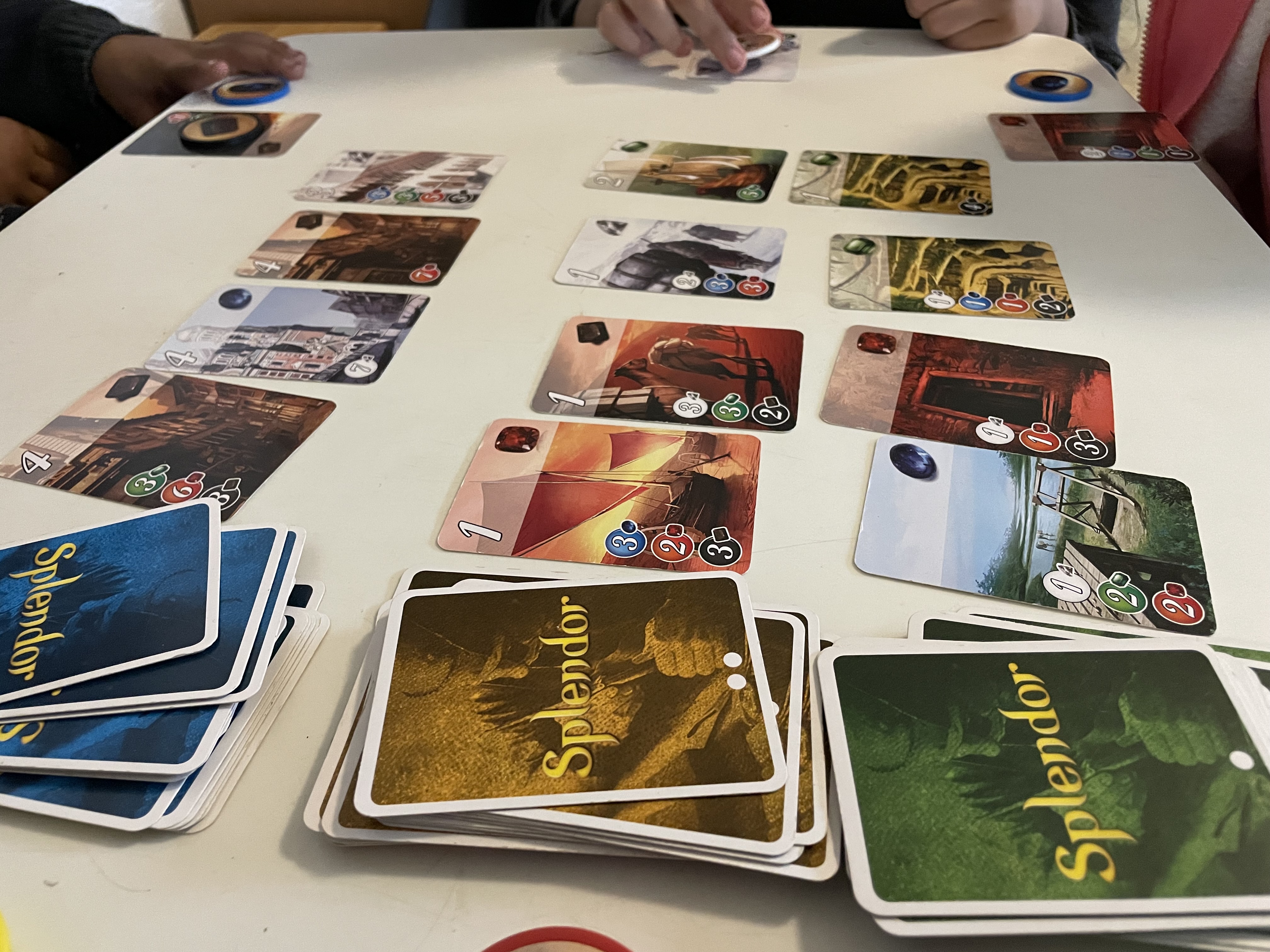
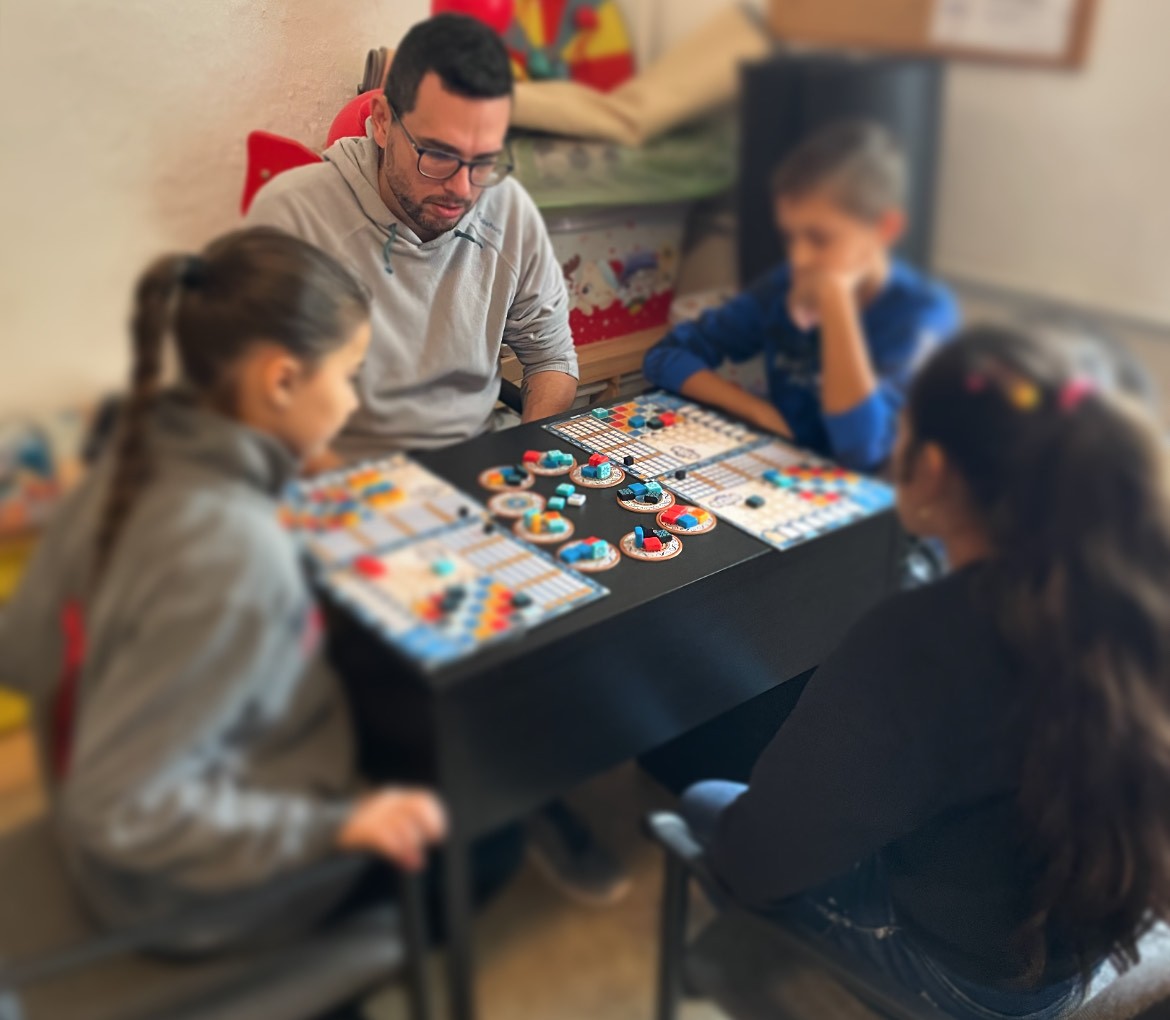
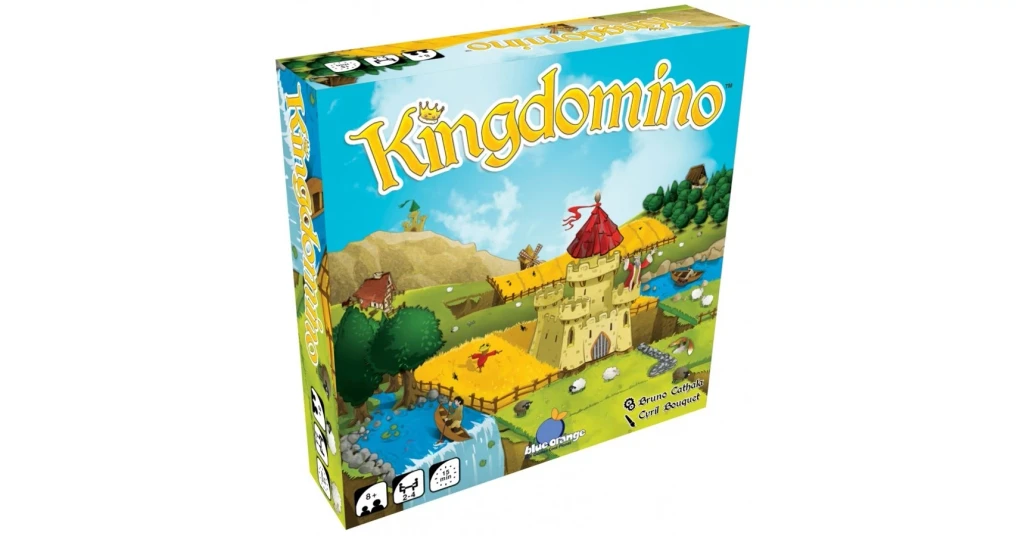
If I must name specific titles, I'll give 3-4 not at all surprising ones: Azul, Kingdomino, or Splendor. Each fits within 20-40 minutes, works well with two or four players, they're huge hits with very simple rules, yet they ask for smart decisions. But if someone is coming from card games, say from Uno, I'd take a smaller step, perhaps with Trio, or if luck-based games are appealing and the dice are important, then maybe I'd open up a new world with Perudo.
Cooperative games
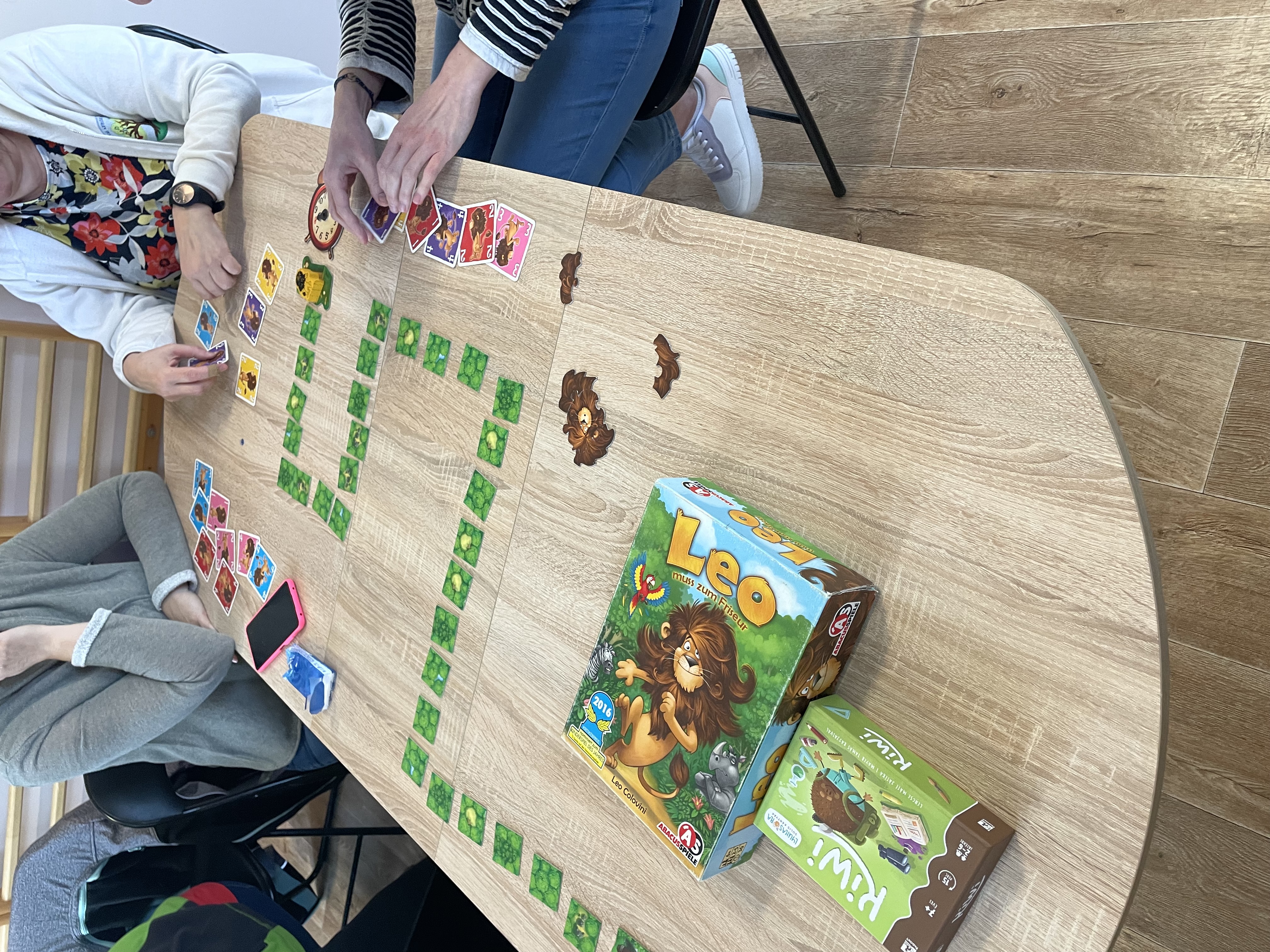
I don't believe that only cooperative games can be good family games, but this is also an exciting, possible path. Here again I can only start from my own experiences; you can make good progress with classics. The lovely The Little Orchard spices up cooperation with a bit of memory, making it a good choice for young ones. Along the memory track, it's worth moving on to Leo, and from age 5 there are already wonderful deductive thinking gems like Outfoxed!. These are all games with very simple rules that ask for little but give a lot, especially as a family experience. These are all perfect information games, so as parents we need to be careful not to solve the game for the children, but a beautiful developmental path can be followed with these games too — perhaps Pandemic is a good end goal among the 8+ games.
If we're looking for a cooperative game where the alpha player problem — the know-it-all who dominates everything — disappears, then it's worth looking at the 2025 Spiel des Jahres winner Bomb Busters, which is 10+ and the theme might be divisive, but it's presented in a cute way and it's a smart game where everyone is responsible for themselves.
Also a Spiel des Jahres winner is Dorfromantik, which can be interesting because it approaches the world of cooperative games in a non-classical way — as a campaign game playable from as young as 6-8, a continuously evolving and developing simple family game.
A cooperative deduction board game where players work together to discover which fox stole Mrs Plumpert's prized pot pie.
The game is perfect for high school students as it offers intellectual stimulation, fosters teamwork, and educates players about global health and geography facts.
Short games — under 30 minutes
The already mentioned Kingdomino is an excellent example that you can make a smart family game in a quick and compact format, but I also tend to say that we should make time. We don't need to think big, but we shouldn't always try to get the board gaming done in 10-20 minutes — it's very exciting and meaningful when there's an opportunity to immerse ourselves in a world, a game structure for 40-50 minutes, and most of the time it's up to us to create those opportunities.
But if we must, here are a few family games that work well for us both at home and in school settings. Sushi Go! can be an excellent choice especially for card game lovers, as the gameplay is very simple and fast, while the scoring can be tricky. And if drafting — selecting game elements — clicks, then Draftosaurus is also a good choice, because here you need to acquire dinosaurs and then place them cleverly for the most points. Both games take under 15 minutes, have great atmosphere, and are thoughtful fun.
Travel games
I've played a huge amount on trains, and what was always easiest for us was the roll-and-write type of game, because everyone gets a sheet they can put on anything, you need a writing instrument, and you can roll dice in the game box — which fits on any small table. The great classic Qwixx, for example, is an excellent entry-level game both into the roll-and-write genre and into family games. A bit newer, a bit cooler, but a similar level, so a good choice might be Calavera. And if we like Tetris-style games but can't spread out pieces while traveling, then Second Chance is a great flip-and-write game — except that instead of rolling, you need to find space for two small decks of cards and off you go with the drawing.
And if the priority is that good family games take up little space in the luggage, then Oink Games board games are excellent choices!
The next level — strategy games
This is a particularly difficult question, precisely because these are difficult games. I don't even want to name specific titles; instead, I'd like to write a bit about the possible paths forward.
One of the most obvious paths is developing within a mechanic. If there's a type — say auction games — that we really love, then we can choose increasingly complex ones from that category, and it will most likely work.
Closely related to this: if we start paying attention to the game designers' names on the box, we'll know whose style appeals to us and whose doesn't. Of course, someone might make great family games but their more complex works aren't as good, but as a starting point, this isn't bad either.
In some cases, it can be useful to follow publishers. If one makes good party games but also has good family games, then there's a chance our tastes align, and what they consider a good strategy game will appeal to us too.
Finally, something else to consider is the game's theme, especially if it matters to us during play. If we try a game with a thematically appealing subject, we'll be more forgiving, more patient, and more willing to wrestle with a more complex structure.
Otherwise, let's go to board game events, ask for recommendations, and try out games to find what suits our taste.
What to avoid
Anything that creates even a bit of resistance in any family member. The essence of family gaming is that everyone likes the game we're about to play. And from there, it's all a matter of taste: can it be long? — if that's what you want, then of course; can it be complex? — if everyone wants to exercise their brain, then why not?
I'd highlight two things in particular, though you can veto these too if that's what works for you. I don't recommend games where there's player elimination and the eliminated player can't rejoin for a long time, because we're excluding them from the shared play, which isn't ideal during family game sessions. The other thing I think is worth avoiding is highly confrontational games — where you have to destroy the other player, ruin their game, kill them, etc. Competition is obviously fine, but I don't think strongly confrontational games are good choices.
Monopoly is NOT a family game
This is exactly why we should finally stop thinking of Monopoly as a family game.
Failures and lessons learned
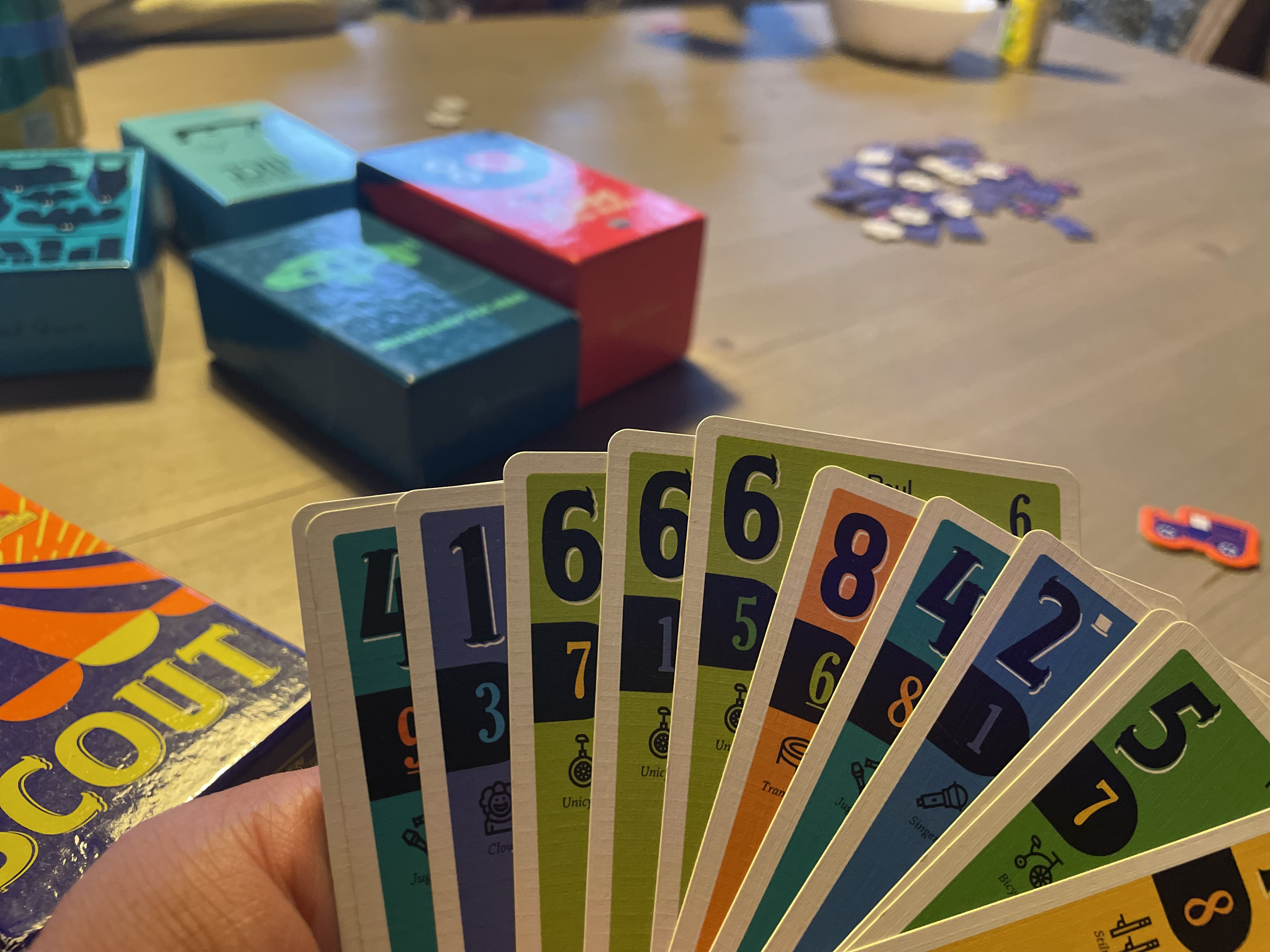
Game selection is a very important part of family board gaming. And not just what I wrote about above — choosing what to play right now — but also what ends up on our shelf at home. At our house, I'm responsible for this, but obviously there are ups and downs here too. Trio, for example, was an incredible hit for us — we have several hundred games behind us — but Jungo or Flip7 only got a few shrugs. When my daughter started enjoying card games, I showed her Scout, which I really love, but it was too clunky for her — it didn't grab her.
It's not about distinguishing good or bad games, but about paying attention to what's compatible with everyone. And I'd emphasize everyone again — family board gaming isn't about catering to the child, but about everyone being happy to be present in the situation, happy to play the given game. Today we have plenty of handholds for game selection: we can borrow, we can go to clubs, board game events, venues — try before we buy. And there are quite a few specialty shops now where they give good advice, and online there's countless content to help our decisions. Let's put in the effort — it's worth it!
Memorable moments — family game culture
I'd like to highlight two things from our own board gaming.
First, that board gaming became part of our older daughter's evening routine. For a long time we were looking for an activity alongside the usual bathing, story reading, and singing — something that helps slow down and arrive at bedtime — and a few years ago we found this in board gaming. I especially love that although we've played many different games over the years, one of my favorite abstract games, Kalaha, is a recurring feature of our evenings, and my daughter regularly wins when she goes first, since she beautifully learned the winning strategy through experience. (By the way, abstract games are great for building a progression too — we wrote about this here.)
The other thing that comes to mind about family board gaming is that we put together packages. On weekends, when we have more time, we can each choose 2-3 games, so everyone's favorites get included, but everyone makes compromises too. Choosing games is a beloved ritual of mine, before vacations for example. Not surprisingly, Oink Games enjoy an advantage there because of their size. And because they're good!
I think the culture of shared family board gaming develops organically. You can introduce a few deliberate rules at the beginning — no phones, no eating at the table, etc. — but then it takes shape: when, what, where, and with whom we play, what's good with two (e.g. Kalaha), what's better with three (Quacks & Co.: Quedlinburg Dash). Everyone has their color — I'm yellow — everyone has their spot, everyone is good at something, everyone has their favorite. And everyone has their style: I know how my daughter rolls, I know what my wife goes for in Azul, etc.
Practical tips for parents
You are the key! I've already written a lot above about game selection and the family game night ritual. But we've only touched on the fact that the adult is the key — everything stands or falls with them. All the responsibility is ours, dear fellow parents, but perhaps we're already used to that. But precisely because of this, it's important that we also feel good in this situation — that's why I consider it important that games we enjoy also make it to the table, that we play with enthusiasm, motivation, and full commitment, so the effect is complete.
We choose the game, we buy it, we usually learn it and we explain it — here's a practical guide for that — we coordinate, we set the frame. But! None of it is worth anything if we don't enjoy ourselves, and that's what we forget most often. Let's not!
And perhaps one more thing — both areas are especially important to us at PlayWise and are worth considering here. You don't need to buy everything. You don't need to spend huge amounts on the latest "amazing and unmissable" board game. Let's borrow, only buy what we'll definitely use, or don't buy anything at all: here's a collection of games you can play with minimal equipment. But let's also be open to alternative, affordable, sustainable solutions like print and play — for example, we have several excellent family card games that can be printed and played for a few dollars. Give them a try!