
20 Questions at a Glance
Why Does It Feel So Familiar?
There are games that feel like you’ve always known them, as if you’ve been playing them for as long as you can remember. You usually can’t even say who taught them to you, because somehow you’ve always known how they work. You never really end up in a situation where the other person doesn’t know what the game is. The rules are simple and clear, there’s nothing to argue about.
On top of that, you don’t need anything to play—and games without equipment are particular favorites of ours—so it can be played with anyone, anytime, anywhere. 20 Questions is exactly this kind of game.
How to Play 20 Questions?

20 questions game rules? It’s so simple that I’m not even sure you can call it a set of rules. One person thinks of something, and the others try to figure out what it is. The rules are simple: you can only ask yes-or-no questions. Typically, you start by identifying the category—living thing or object, for example—and then gradually work your way closer to the solution. A classic deductive game.
How to play 20 Questions over text?
The answer is very simple: one of you asks questions, the other answers. Then you switch roles. That’s it. The game works anywhere and in any form: over text messages, on the phone, while walking down the street, or lying on the beach. All you need is two people.
Hungary, for example, we don’t usually set a limit on how many questions can be asked—we don’t even count them—but the English name highlights that framework. In Hungary, everyone knows the game as Barchoba: it was played by a famous Hungarian writer and his literary circle in the Budapest New York Café in the early twentieth century, and the name itself comes from Simon Bar Kochba.
Personal experiences
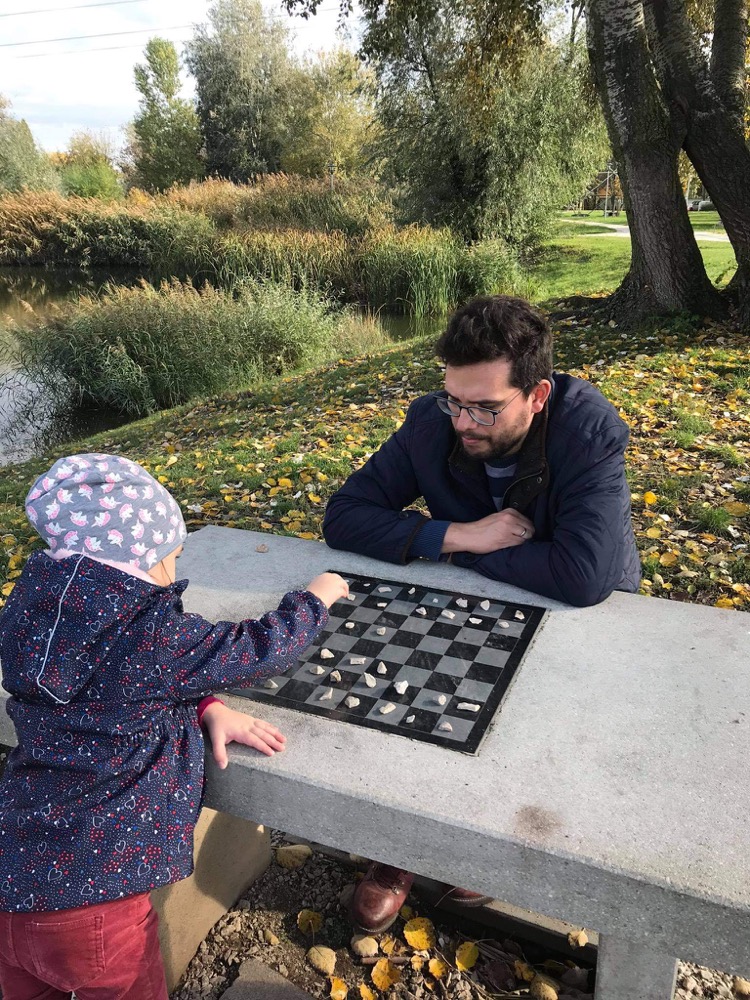
Even though we have more than 400 board games in our apartment, this is probably the game I’ve played the most with my now nine-year-old daughter. The reason is very simple: you don’t need anything to play it, you can start at any moment, as long as you’re able to pay a bit of attention to each other, and it doesn’t take long—unless, of course, you play many rounds in a row.
What I also see as key is that it can remain a game in the most honest sense of the word, because there’s nothing at stake. We don’t keep track of who guesses correctly how many times, we don’t compete—we play simply because the game itself is interesting, for the sheer act of playing. And that feels really good.
We play it while walking to school, in the car, on the train, and even on regular city public transport—during hikes, or simply lying on the living room carpet, escaping boredom.
We play simply because the game itself is interesting, for the sheer act of playing. And that feels really good.”
Is it a board game or not?
One of my favorite “debates” is when we argue about whether a given game counts as a board game at all. This probably comes up most often with The Mind. And it’s especially easy to argue when a game doesn’t even require any components.
That said, instead of getting lost in endless debates, I’d still recommend playing 20 Questions or The Mind even if you don’t consider them board games—because what is certain is that they’re great fun and they really get your brain working.
But! Two games came to mind that clearly build on 20 Questions, using it purely as a game mechanic. One is the classic Mastermind, where you ask questions with colored pegs until you crack the hidden combination. The other is Similo, which turns the idea on its head: it skips the questions and works only with answers, but the underlying logic is the same. You could even think of this simple, spoken game as the ancestor of deductive board games.
Pedagogical Considerations
Whether I look at it as a parent or as an educator, 20 Questions is an excellent game. Before diving into its pedagogical impact, it’s important to say that games should always be played for the experience of play itself—this is a core principle of board-game pedagogy. You won’t convince a child by saying, “This will lead to incredible language development,” or by explaining how useful deductive thinking is.
The play situation has to be motivating; the child has to want to play with you. The benefits can be present in your own mind, but you should be there in the game as a fellow player, and let the game itself do its work.
The importance of asking questions is undeniable. This has always been true—whether in the age of Google or now, in the age of AI. That’s why it saddens me when education doesn’t give this enough space, when children’s questions bother educators instead of being welcomed. An educational system that mostly produces individuals who can’t ask questions, or are afraid of asking them, is simply dysfunctional.
As a teacher, I’ve very often seen children—and even university students—hold back their questions out of fear of being seen as foolish. Children usually encounter 20 Questions at an age when asking questions still feels natural to them. That’s precisely why the game is so popular, and why they enjoy it so much. And it genuinely teaches deductive logic and smart questioning—especially when there’s a limit on how many questions can be asked.
I particularly love the moment when, after some initial groping in the dark and a few seemingly irrelevant questions, the process suddenly clicks and the children arrive at the solution. In a short time, you can watch them move from hopelessness to insight, having received nothing but yes-or-no answers along the way.
It’s also important to emphasize that we’re talking about a language-based game as well. Formulating the right questions, phrasing them well, and interpreting the answers are not just logical tasks—in fact, for the game to become a logical exercise at all, understanding is essential.
And of course, it’s also worth highlighting that 20 Questions is very well suited for knowledge building and content learning, making it a great tool for developing general knowledge. By the time we figure out that the answer is, say, a tiger, we’ve already learned a great deal about it—its size, color, habitat, what it eats, and so on. Over many rounds of play, this kind of knowledge can become organically embedded in a child’s understanding.
Age-Based Adaptation
As a game designer, one of the hardest moments is having to make the final decision together with the publisher about the age recommendation that will go on the box. It’s a difficult and definitive choice. Even if I later say in a rules explanation video that younger children can also play, the product has already been labeled, and that’s what people will base their decisions on in stores and webshops. Not everyone will buy a 6+ game for a preschooler—many will see it as something meant for school-aged children.
Games like 20 Questions, however, don’t require us to decide from what age they can be played. That’s because the age recommendation is determined by the content of the game—and in this case, the content is defined by the players themselves. You can play with philosophical concepts or with cute little animals. The game can be very personal, very concrete (objects in the room), or something entirely abstract, like a philosophical idea. The game remains the same; the target audience changes.
Variations
Personally, I’m very much in favor of adapting games to fit our goals—and in the case of these kinds of “open-source” games, this is especially true. You can play with the number of questions: the fewer you allow, the harder the challenge becomes. You can also give the adult only ten questions and the child twenty, subtly introducing a bit of handicap balancing into the game.
Narrowing down the theme is another way to add variety. You can lean into humor with ideas like allowing questions only if they use one-syllable words—or you can come up with countless other twists. For example, everyone is allowed to lie once. But will you notice when you’re being led completely astray? This trick works well in the team version too. When playing in teams, I find the dynamics especially interesting: do players discuss the questions together, who gets to decide, does a kind of sub-player emerge?
The Lying Variation
Everyone is allowed to lie once. But will you notice when you're being led completely astray? This trick works well in the team version too.
What to Ask in 20 Questions
What makes a good question? At first, I tend to think it’s one that rules out many possibilities. Is it a living thing? Then it becomes increasingly useful to step into your fellow player’s head, because if you can ask questions in a more personalized way, you can avoid a lot of unnecessary rounds. For example, I like to ask about shared experiences, since my daughter often chooses an animal from there. Have we seen it at the zoo? Does it appear in your favorite story?
Toward the end, you sometimes have to take risks and ask questions that promise a big payoff if the answer is yes, but help almost not at all if it’s no. Is it striped? I strongly believe in spontaneous, experience-based learning, so I don’t teach children how to ask the “right” questions. Instead, I try to do it well myself and trust that we’ll have plenty of time together, plenty of chances to play, and that they’ll be able to learn from me.
This is also closely connected to letting them make mistakes. You can learn a lot from mistakes. If I point out that a question was bad because it asked about something we already knew, they’ll simply ask another one. But if they realize on their own that they’ve wasted a question and that this is why they’re running out of their question limit, that’s experiential learning. If it doesn’t happen the first time, it will by the fifth—there’s no need to rush. Let learning happen and settle in deeply, during a spontaneous and joyful activity.
Questions to ask when playing 20 questions: Whatever comes to mind, just casually! Is it alive? Is it an object? Is it a person? Does it still exist? Is it real or fictional? Is it bigger than a loaf of bread? Does it fit in your pocket? Do you use it every day? Is it indoors? Is it outdoors? Does it move? Can it talk? Was it made by humans? Is it old? Is it modern? Is it expensive? Is it related to technology? Is it related to food? Is it an animal? Is it more than one color?
"Animal?"— almost always the very first question Máté’s daughter asks.
Why Is 20 Questions Important to PlayWise?
At PlayWise, we strongly believe that despite the golden age of board games, the very understanding of what play truly is is somewhat at risk. The overwhelming flood that characterizes today’s board game market can easily make us believe that a board game is only something that comes in a box, is colorful, costs a lot of money, and sits on store shelves. But that’s not what makes a game good.
With this article, we wanted to show just how much depth there can be in a game this simple. It requires nothing, has hardly any rules, everyone already knows it—and yet it can still be an enjoyable and meaningful way to spend time. PlayWise is not about claiming that all classic board games are bad, nor that all equipment-free games are good. It’s about the idea that a game is good if it’s good to play.
If it works for you there and then, if it brings joy—and maybe even supports development along the way—then it’s a good game. That game might be the thousands-of-years-old Go, it might be the latest Spiel des Jahres winner Bomb Busters, and it can absolutely be 20 Questions as well. The key is to keep looking for the play experience itself—because that’s the only way we have a real chance of finding it.
a game is good if it's good to play”
How to Win at 20 Questions
Typically, this is the kind of game where you already win the moment you start playing. I believe this should be the basis of every game, but in games like Barchoba, where there is no stake, few rules, no equipment, and a light, easy feel, this pressure can truly disappear. And this is good!