I was standing in front of the board game shelf, looking for something to play. I love this activity. Most of the time, I browse before trainings, searching for examples that fit my educational goals — but finding the perfect game for home play is just as much fun.
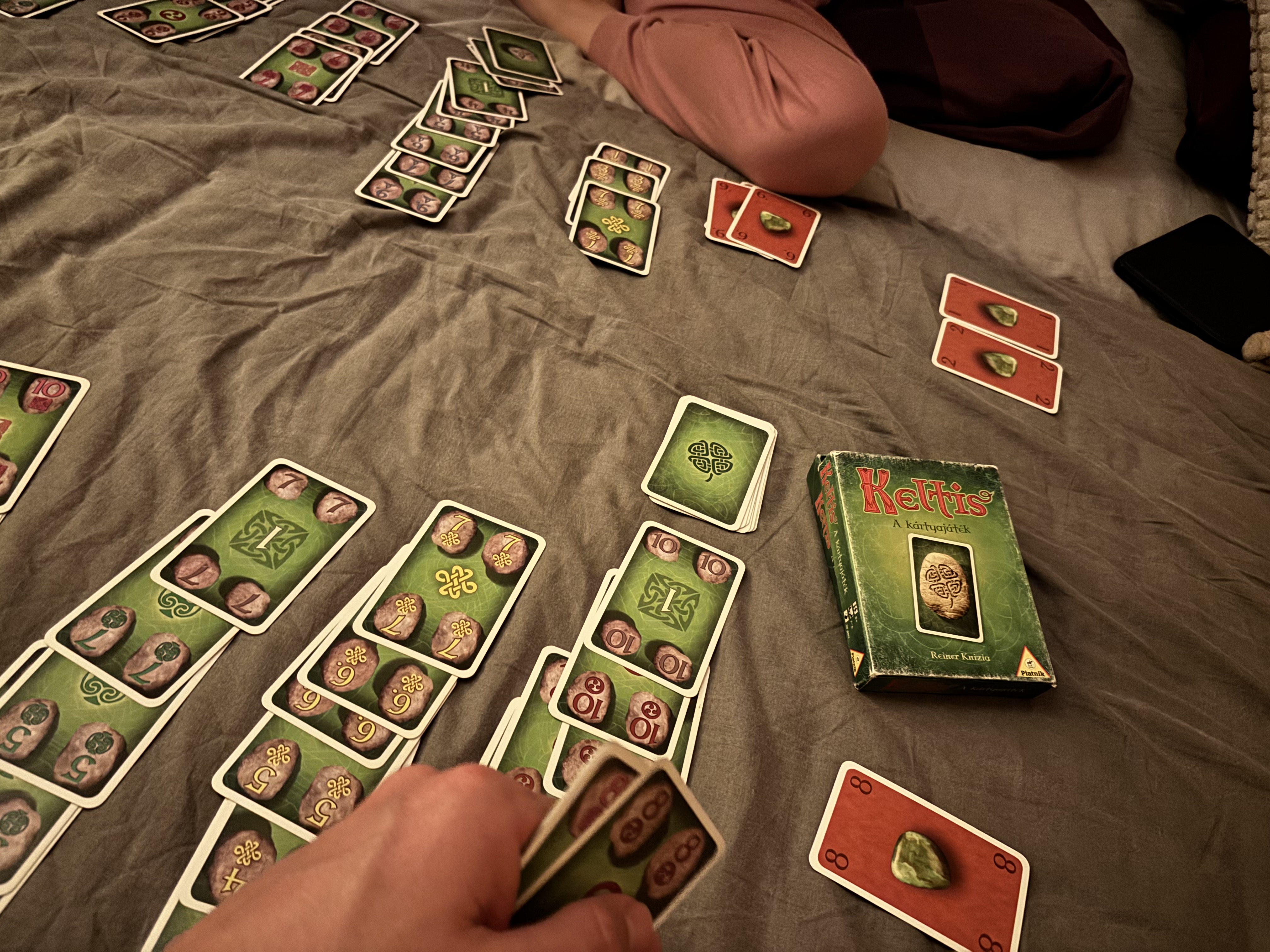
I’ve written several times that in our family, playing a board game is part of the evening routine with my older daughter. Lately, we’ve been diving into one game at a time for about a month. In February, it was the card game version of Keltis that made it to the table — or rather, to the bed, since that’s where we usually play.
I’m not entirely sure why I chose it. I wanted to teach something new — something not too long, fairly simple, and that I personally enjoy. And then, somehow, this little box caught my eye on the shelf.
The box was quite worn, and the cards weren’t in great condition either. That immediately reminded me how much we used to play it years ago — at the afterschool program with the kids, and even among colleagues. We played it a lot. Then, somehow, it faded away.
I know exactly what my daughter likes and what she usually plays, so I did have my doubts. In January, for example, we were throwing markers and coloring in Takenokolor — compared to that, Knizia’s classic feels rather old-school: a simple, straightforward card game.
You play a card, you draw a card. Sometimes you discard two cards to gain a bonus — and that’s basically it. Colored number cards, color sequences, nothing extraordinary. Yet, as is often the case with Knizia, there’s clever scoring, smart balance, risk-taking, rhythm. It’s astonishing how much depth he can slip into a few simple cards — and I realized that my nine-year-old daughter is open to exactly that.
We play every other evening, so we’re around fifteen games in. She has won only once. It’s clear that, even though it’s “just” a card game, victory is not simply a matter of luck. And yet she’s always the one who asks to play and sets it up — so she clearly loves it.
This is important to me for two reasons.
First, seeing that alongside all the flashy, eye-catching games, a stripped-down but intelligent design like this can still captivate her shows me that I’m not talking into the void when I keep introducing different games. It’s the way a game works — the experience it creates — that draws her in, not (only) the aesthetics, even at eight or nine years old.
Second, it reassures me that it’s possible to build a board game culture anywhere in which whether the child wins is secondary. In trainings, people often ask me how to teach children to lose, or how to avoid those situations altogether. Meanwhile, my daughter happily loses again and again — because she’s curious to figure the game out, because she enjoys it, and because she can feel herself improving. Her scores are steadily getting better. She truly is getting stronger. And when everything finally came together once, she won.
So let’s not fall for every flashy new release. Let’s keep believing in the classics — in structures that may seem simple at first glance — because they just might still enchant today’s children, too.