
Playing alone doesn't require a table full of components either. Some of the most engaging solo experiences come from games that use nothing more than a deck of cards, a sheet of paper, or a single die—and sometimes not even that. In this article, I explore solitaire games, classic patience variants, print-and-play titles, and a few of my own minimalist designs that prove how much gameplay can emerge from very little.
Solitaire Dice
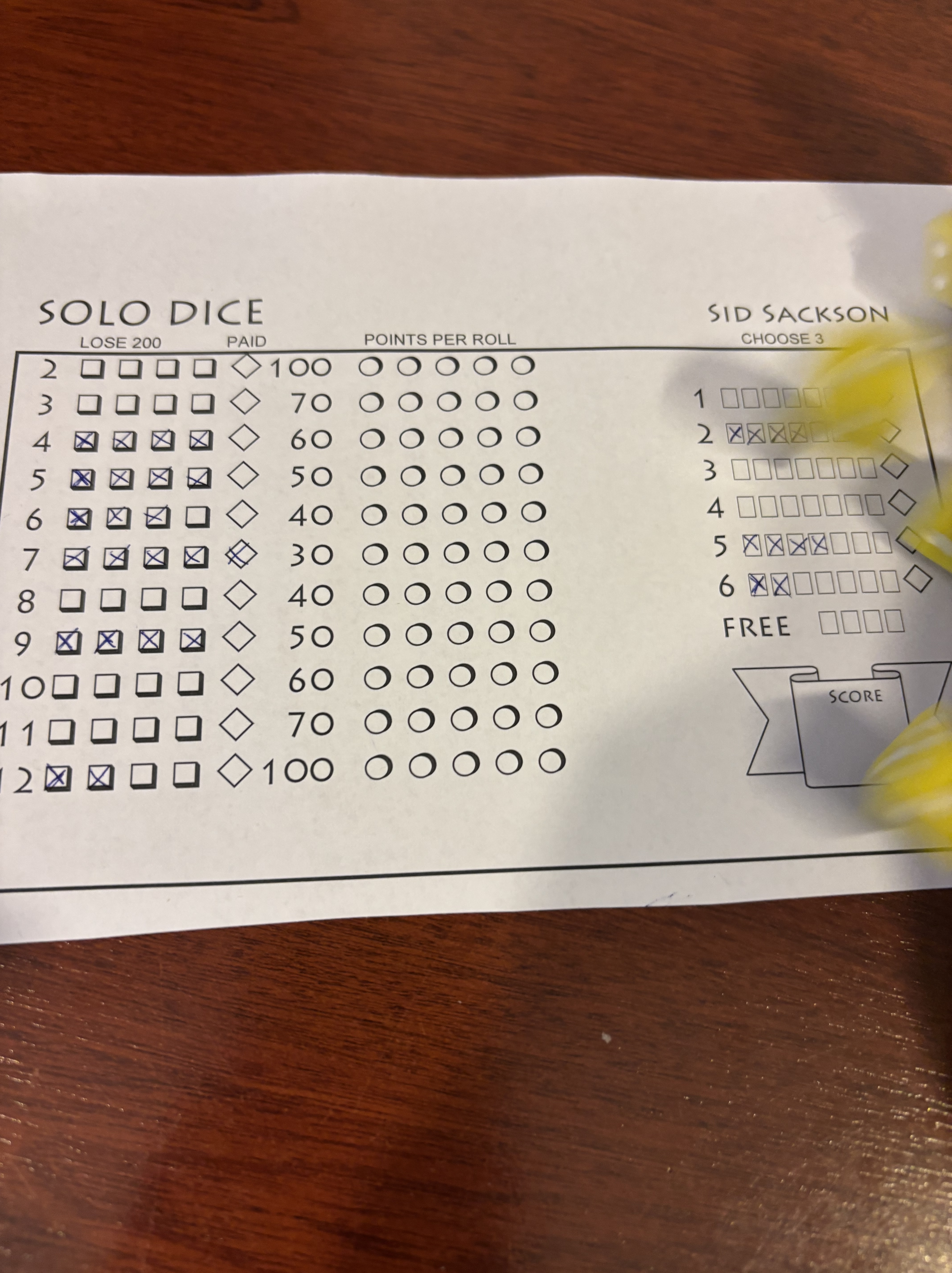
I'd like to start by recommending Sid Sackson's 1969 game. All you need are five dice—optionally you can print a score sheet from the BGG page, but that's by no means essential; you can easily track the rolls on a piece of paper as well. The rules are very simple, the gameplay is very straightforward, yet it's a smart, thoughtful experience where luck can still have a major influence on what happens.
Looking at it through an educator's lens, several things immediately come to mind: combinatorial thinking, decision-making under uncertainty, push-your-luck elements, pattern recognition, and probabilistic intuition. The full rules are available via the link, but briefly, the gameplay goes like this: you roll all five dice at once, form two pairs, record their values (by adding up the two dice in each pair), and also record the remaining fifth die. From the collected values, at least five identical entries are needed to score points—check the scoring table for details—and the game continues until one value has been chosen as the fifth die for the eighth time.
In the first few plays, even reaching a positive score is a challenge, but thanks to its incredibly elegant and clever rule set, this becomes a highly engaging, simple, and quick game that delivers a lot of fun with virtually zero material investment.
(Sid Sackson's book Games of Art was a huge source of inspiration for our coloring games.)
Solitaire (Patience)
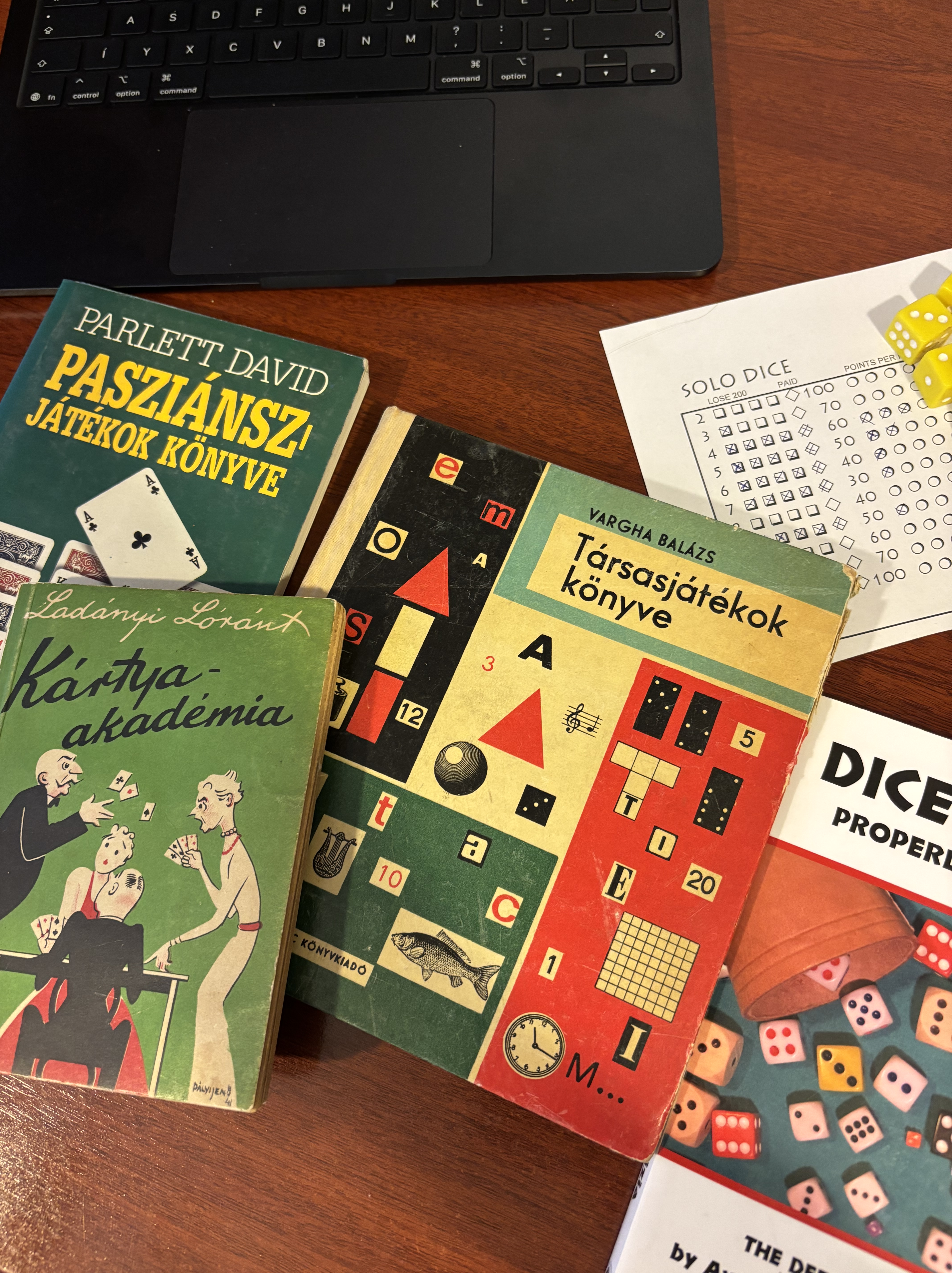
I know we mostly play this online—thanks to Windows—but it's worth digging up a deck of cards from somewhere and seeing what it adds to the flow of the game when the cards are actually in your hands: a little worn, slightly bent, maybe a bit dirty, carrying the traces of past games. We shouldn't underestimate the impact of that. Playing board games is a way of checking out of the digital world. When I play solitaire on a computer, notifications inevitably start pinging, I think about checking the news, I'm just clicking away, and there's no real stake—after all, restarting takes a single button press.
In the physical world, though, you have to gather the cards, shuffle them, and set the game up again. Your decisions carry more weight, because you're playing in a different space, a different context, with a different mindset. And if we're looking for even more reasons to play solitaire in person with real cards, there's the sheer number of variations available. When it comes to card games, David Parlett is a name well worth remembering. His book Card Games for One collects a huge number of variations, and it's also worth browsing his website once you've played the classic form of solitaire to exhaustion.
Solitaire (Peg Solitaire)
I think many people will be familiar with this game as well. In fact, at first it might even seem strange to find it on this list, since it normally requires a board and quite a few pieces. Yes, a bit of creativity is needed—I won't deny that—but I think it's well worth it. Pebbles, buttons, beans, or anything similar aren't hard to come by, and once you have those, all you need to do is set up the board. You can even draw it into the sand on the ground, sketch it with chalk on the pavement, or simply draw it on a sheet of paper with a pencil.
Several different starting setups can be found on BGG, but the game itself is always the same: you jump pieces over one another so that, in the end, only a single piece, bean, pebble, or button remains on the board. A jump is only allowed if two markers are directly next to each other and there is an empty space immediately beyond the jumped piece in the direction of the move. See? Not complicated at all. Of course, understanding the rules is easy—executing them flawlessly is another matter entirely.
There are plenty of simple challenges and puzzles available for solo play. Some do require special equipment, like a Rubik's Cube or Mondrian Blocks, but many are based on everyday items. Even simple chess puzzles come to mind: they're highly entertaining, and you certainly don't need to be a grandmaster to enjoy them—and most households do have a chess set. Or don't they?
Print and Play
You can also browse solo print-and-play games on our site—we have plenty of previews available—but there are two small, self-designed print-and-play microgames that fit this article particularly well. The first one I'd recommend is Num Tag, which can even be played without printing anything at all: you just need hand-drawn cards and a few dice. While it supports multiple players, the solo version is especially exciting and cleverly designed.
The other one worth trying is Mark & Play, a bookmark-sized game that only requires your current reading material, a bit of linguistic creativity, and some tactical thinking.
Closing Thoughts
As I mentioned earlier, solo board games still aren't truly popular in Hungary, but I encourage everyone to give this genre a try. And while there are expensive, big-box masterpieces in this category, the examples above—and a few guiding thoughts—aimed to show that high-quality gameplay can also emerge from very few components. It's well worth giving it a go. Happy gaming!