You're hanging out with friends — maybe waiting somewhere, maybe at someone's place, maybe just bored. No board games in sight, no cards, nothing. You pull out your phone and search: "what can we play?" This is that list. We've tested every game here in real settings — from educator workshops to living room hangouts — and picked the ones that actually work. Looking for games in other situations? Check out our complete guide to games without equipment, or browse games for families, nature, or summer travel.
Quick reference table
Find the right game at a glance. Click any name to jump to its full description.
| Game | Type | Players | Vibe |
|---|---|---|---|
| 20 Questions | Guessing | 2+ | Chill |
| Word Chain | Word | 2+ | Chill |
| Contact | Word/Guessing | 3+ | Focused |
| Ghost | Word | 2+ | Chill |
| I Spy | Guessing | 2+ | Chill |
| Categories | Word | 2+ | Chill |
| Black, White, Yes, No | Word | 2+ | Tricky |
| Hangman | Word | 2+ | Chill |
| Two Truths and a Lie | Social | 3+ | Icebreaker |
| Never Have I Ever | Social | 3+ | Party |
| Would You Rather | Social | 2+ | Fun debate |
| Truth or Dare | Party | 2+ | Wild |
| Charades | Party | 4+ | Active/Loud |
| The Question Game | Social | 2+ | Tricky |
| Mafia / Winking Murderer | Deduction | 6+ | Intense |
| One-Word Story | Creative | 3+ | Silly |
| Fortunately / Unfortunately | Creative | 2+ | Funny |
| Telephone | Silly | 5+ | Hilarious |
| Simon Says | Active | 3+ | Energizing |
| Ninja | Active | 4+ | Physical |
| Rock-Paper-Scissors | Active | 2+ | Quick |
| Evolution | Active | 6+ | Energizing |
| Word Bridge | Word/Team | 4+ (pairs) | Deep |
| Triangles | Movement | 10+ | Flow |
Word & guessing games
These games run on vocabulary, deduction, and clever thinking. They're quiet enough for any setting and endlessly replayable.
20 Questions (Barchoba)
One player thinks of something — an object, a person, a concept. Everyone else asks yes-or-no questions to narrow it down. You get 20 questions total. The beauty is in the deduction: a well-placed question can eliminate hundreds of possibilities at once, while a lazy question wastes everyone's time.
This is Mate's go-to game for two players and a classic for car rides. We've written a full deep-dive on 20 Questions if you want strategies and variations.
Word Chain
Someone says a word. The next person says a word that starts with the last letter of the previous word. "Elephant" — "Tiger" — "Rainbow" — and so on. No repeats allowed.
A simple word chain is a great game on its own, but an even looser version — a pure association chain where each word just has to relate to the previous one — can be surprisingly entertaining. You'll learn a lot about how your friends think.
Contact
One player thinks of a word and reveals only its first letter. The other players try to guess the word, but they can't just shout guesses — they have to give clues to each other. If two guessers think they're on the same page, they say "Contact!" and count down to say the word simultaneously. If they match, the thinker must reveal the next letter. If the thinker figures out what they're hinting at first, they can block it.

Ghost
Players take turns adding one letter to a growing word fragment. The catch: you must have a real word in mind, but you lose if you're the one who completes a word. So you're constantly trying to steer the fragment toward a word that the next player will have to finish.
As simple as it sounds, it's surprisingly tricky — and your vocabulary matters more than you'd expect. A great pick for two friends who like a quiet mental duel.
I Spy!
I Spy is essentially a guessing game that tests your powers of observation. Brilliant for road trips or a quiet afternoon indoors.
Here's how to play it. One player selects an object in their immediate vicinity and says, "I spy with my little eye something that is..." followed by a descriptor of the object, such as its color, shape, or size. The other players then take turns guessing what the object might be.
The pros of 'I Spy' are many. It's an excellent game for developing observation skills and vocabulary. Plus, it's the ultimate portable game - all you need is somewhere to look!
Categories
Pick a category — countries, animals, movies, foods that start with "B" — and go around the circle. Each person must name something that fits. Hesitate too long or repeat an answer, and you're out. Simple to explain, endlessly customizable, and it can get surprisingly competitive.
Black, White, Yes, No
A classic: your goal is to ask questions that trick the other player into saying one of four forbidden words — "black," "white," "yes," or "no." The answerer must respond truthfully to every question without ever using those words. It sounds easy until someone fires off a rapid sequence of obvious yes/no questions and your brain short-circuits.
Hangman
Good old Hangman, a game that brings back some school lunchtime memories for me! You've got a word to guess, but if you err too many times, your scribbled stick figure meets an unfortunate end.
Playing Hangman is as simple as it is engaging. One participant thinks of a word and draws a blank line for each letter of that word. The other players then guess letters, one at a time. If a guessed letter is in the word, it's written in the appropriate blank(s). If not, one part of the 'hangman' is drawn. The goal is to guess the word before the hangman drawing is completed.
A clear-cut pro of Hangman is that it's a prime tool to enhance vocabulary and spelling skills. It also allows for some serious deductive reasoning.

Social & party games
These games are about people — reading each other, sharing stories, and getting to know your friends (or strangers) better.
Two Truths and a Lie
Each person shares three statements about themselves — two are true, one is a lie. The group tries to spot the lie. That's it. But the game is richer than it seems: you have to think about what you want to reveal about yourself, decide what's believable and what isn't, and face the sometimes-surprising assumptions people make about you.
This is one of the best icebreaker games there is. It supports both self-awareness and getting to know others, making it a great foundation for further bonding.
Never Have I Ever
"Never Have I Ever" is a popular party game that puts your truths (and those of your friends) front and center! It's a great way to get to know your friends a little bit better. Everyone sits in a circle and takes turns saying something they've never done before, starting the sentence with "Never have I ever...". Everyone who has done the thing mentioned puts a finger down (or takes a sip — adapt it to your group). The more diverse the experiences, the funnier the game gets!
This game is arguably more interesting as an adult. Saying "I've never been abroad" means something very different at age 6 versus age 30 — and that's what makes it so revealing and engaging with a longer life behind you.
Would You Rather
"Would you rather be able to fly or be invisible?" Someone poses a dilemma with two options, and everyone picks a side and defends their choice. The fun is in the debate, not the answer. The best questions are the ones where both options are equally appealing (or equally terrible). You can keep it lighthearted or go deep — your call.
Truth or Dare, a classic!
The game is all about a daring test of honesty and boldness among a group of friends. The mechanics? They're as simple as pie.
First, gather around in a circle and decide who gets to play the inquisitor first. This person will choose a target and utter the phrase, "truth or dare." The target must then choose between revealing a truth (usually a secret, something personal, or answering a pressing query from the group) or performing a dare (which can be anything from the hilariously silly to the downright outrageous).
Pros of 'Truth or Dare' include hilarious fun, bonding time with friends, and a chance to reveal interesting details about each other. But like any game, it also has its bumps. Things could get too personal, pranks might go wrong, or someone could end up feeling uncomfortable. It's important to set boundaries before getting started.
Unlike solitary screen-based activities, board games encourage face-to-face interaction. People must communicate, collaborate, and negotiate with each other, fostering essential social skills such as teamwork and empathy.
Charades
Act out a word or phrase without speaking — your team tries to guess what it is. No words, no pointing at objects, just your body and creativity. Split into two teams for a competitive twist, or just take turns in a circle for a more relaxed vibe.
The Question Game
Two players face off. The only rule: you can only respond with questions. The moment you make a statement, hesitate too long, or repeat a question, you lose. It requires quick reactions and is nowhere near as easy as it sounds from the rules alone. A brilliant warm-up or a fun mini-duel between rounds of other games.
Mafia / Winking Murderer
These are secret role games at their core — and that's what makes them so exciting. One or more players receive a hidden role (the "killer" or "mafia"), and the rest must figure out who they are through discussion, deduction, and reading non-verbal cues. The killers, meanwhile, try to eliminate others without getting caught.
The simplest version — Winking Murderer — needs no moderator: the killer eliminates people by secretly winking at them. The full Mafia version adds day/night phases and a moderator. Both are huge favorites, especially in group settings like camps.
Storytelling & creative games
These games tap into imagination and improvisation. Expect unexpected stories and a lot of laughter.
One-Word Story
Sit in a circle and build a story together — one word at a time. Each person adds exactly one word. The story will inevitably go off the rails, and that's the point. It trains listening, quick thinking, and the ability to build on what others contribute. Bonus rule: try to actually make it a coherent story instead of sabotaging it.
Fortunately / Unfortunately
One person starts with a scenario: "I went to the park." The next person adds a twist starting with "Unfortunately..." ("Unfortunately, a bear was there.") The next person counters with "Fortunately..." ("Fortunately, the bear was wearing a party hat and wanted to be friends.") Keep alternating. The story spirals beautifully. Requires quick reactions and is deceptively hard to do well.
Telephone
Sit in a line or circle. The first person whispers a phrase to the next, who whispers what they heard to the next, and so on. The last person says the phrase out loud — and it's almost never what started. The longer and more complex the original phrase, the funnier the result. A timeless classic for a reason.
Active games
When you need to burn some energy or break up a stretch of talking games, these get everyone moving.
Simon Says
One player is "Simon" and gives commands: "Simon says touch your nose!" Everyone must obey — but only if the command starts with "Simon says." If Simon just says "Touch your nose!" and you do it, you're out. The faster Simon goes, the more people slip up. An energizer that sharpens attention.
Ninja
Stand in a circle. On each turn, you make one swift movement — trying to slap another player's hand while they try to dodge. Then you freeze in your new position. If your hand gets hit, it's out. Last player with a hand still in wins.
Mate uses Ninja primarily with kids, but it works for all ages. It's a great energizer that demands sharp attention — especially useful when you've been playing too many intellectual games and need to loosen up. Note: since it involves physical contact, make sure everyone in the group is comfortable with that.
Rock-Paper-Scissors
The ultimate zero-equipment decision maker. Both players count to three and simultaneously throw one of three hand signs: rock (fist), paper (flat hand), or scissors (two fingers). Rock crushes scissors, scissors cuts paper, paper covers rock. A tie means you go again.
On its own it's a quick settling tool — who goes first, who gets the last slice, who has to tell the story. But it's also the foundation for more elaborate games like Evolution below. You can play best-of-three, best-of-five, or turn it into a tournament bracket with a bigger group.
Evolution
Everyone starts as an "egg" (crouching down). Find another egg and play rock-paper-scissors. The winner evolves to "chicken" (walking around while clucking and flapping). Chickens play against other chickens — the winner becomes a "dinosaur" (stomping around with tiny arms), and finally a "superhero" (arms raised triumphantly). Losers devolve one stage. You can only challenge someone at your same level.
It's loud, chaotic, and incredibly fun — a perfect icebreaker or energy booster for large groups. The room fills with people at different stages crouching, clucking, and stomping, all looking for their next opponent. First person to reach superhero wins.
Mate's picks: games you won't find elsewhere
These games come from Mate's workshops and training sessions. You won't find them on typical "games to play" lists — but they're some of the best games we know.
Word Bridge
How to play: You need an even number of players, sitting in pairs facing each other. All the "A" players sit on one side, their partners ("B") on the other. An A player thinks of a compound word (like "sunflower") and tells it to all A players. Then A players take turns giving their B partner a one-word clue — everyone hears every clue, but only the matching B partner may guess.
A correct guess earns the pair a point. A wrong guess loses a point. You can also pass. If nobody guesses after the first round, the second A player gives another one-word clue for the same word, and their B partner gets to guess. And so on.
Triangles
How to play: You need at least 10 people and enough space to move around. Stand in a circle. Silently, each player picks two other players as their reference points. On "Go!", everyone must move to form a perfect equilateral triangle with their two chosen reference points. No talking allowed.
The moment one person moves, it creates a chain reaction — because everyone's triangle depends on everyone else's position. The group shifts and flows like a living system until it finds equilibrium. The whole process takes a few minutes, and it feels like a flow experience.
You can add variations: "Nobody can choose someone wearing green" or "Everyone must have Player X as one reference point" — then watch how one person's movement affects the whole group differently. This game beautifully illustrates how systems (like organizations) work, and can spark interesting discussions afterward. But even without the reflection, it's a fascinating and entertaining experience. Mate's first choice for 20 friends in a room with space to move.
Games for just two friends
Not every gathering is a party. Here are games that work great when it's just the two of you.
20 Questions
Mate's all-time favorite for two players. Pure deduction, infinite replayability. See above.
Ghost
A quiet mental duel that rewards a big vocabulary. See above.
The Question Game
Fast-paced verbal sparring where only questions are allowed. See above.
Black, White, Yes, No
Try to trick your opponent into saying a forbidden word. See above.
Games with minimal equipment
These games need a die, a few pebbles, or some cards — everyday items you can find in almost any home. We keep them here because they carry the same message as the equipment-free games above: a game doesn't need a big, colorful, expensive box to be a real game. Play is all around us — you just have to look.
NIM (played with pebbles)
If you have children, then you likely have a bunch of pebbles at home that you can finally put to use. But if not, you can play this game with buttons, matchsticks, or anything else that can be arranged into piles. There are many variations, let's now look at the one where you arrange 15 pebbles (or whatever you're using) into piles of 5, 4, 3, 2, and 1, like this:

The game can be played by two people. Taking turns, players pick up pebbles, and the winner is the one who can pick up the last pebble. The only rule for picking up is that you can only take from one pile per turn, but you can take any number from that pile. So, if you choose the pile with 4 pebbles, you can pick up 1, 2, 3, or 4 pebbles—it's your choice, but you can't take from another pile in that turn!
And if you have not just 15, but also 16 pebbles, then arrange them into four columns of four pebbles each, like this:

In this case, the rule is that you can only pick up adjacent pebbles from the same row or column (so you can't pick up pebbles at once where a gap forms), which adds a new challenge to the game.
But if you're just looking to have fun, play the game with food (snacks?) – whatever you pick up, you have to eat (or drink). This adds a new dimension to the game, as it might not be wise to pick up all five items from a 5-pebble pile, but if those 5 cubes are delicious chocolates, then it might be worth considering.
Pig (played with one die)
For Pig, you only need a single die and at least two players, though it works well with four or five players too. The winner is the one who first reaches 100 points, which you accumulate by adding up the values of your rolls. When it's your turn, you simply roll and add up the value of your rolls.
For instance, a roll of 5 followed by a roll of 6 means you have 11 points. But be careful! The twist of the game is that if you roll a 1, you reset your score for that round. So, if you roll a 5 and a 6 and then a 1, you score 0 points for that round and must pass the die to the next player. You can prevent this by writing down your accumulated points. For example, if you roll a 6, a 4, and a 3, you can choose to write down these 13 points, which are then safe. However, you must then also pass the die to the next player, ending your turn.
Remember: your turn also ends if you roll a 1. The first player to reach or exceed 100 points wins the game.
Pig is a real mischievous game; it always surprises me how well it can hold attention. Nobody checks out when it's not their turn because we must pay attention to the others, in case they also roll a one, and we can tease them a bit.
Katego (2 dice - and some brain)
Katego is a slightly more complex game, as it requires not just 1, but 2 dice to play, and also a table like this, which isn't too complicated:
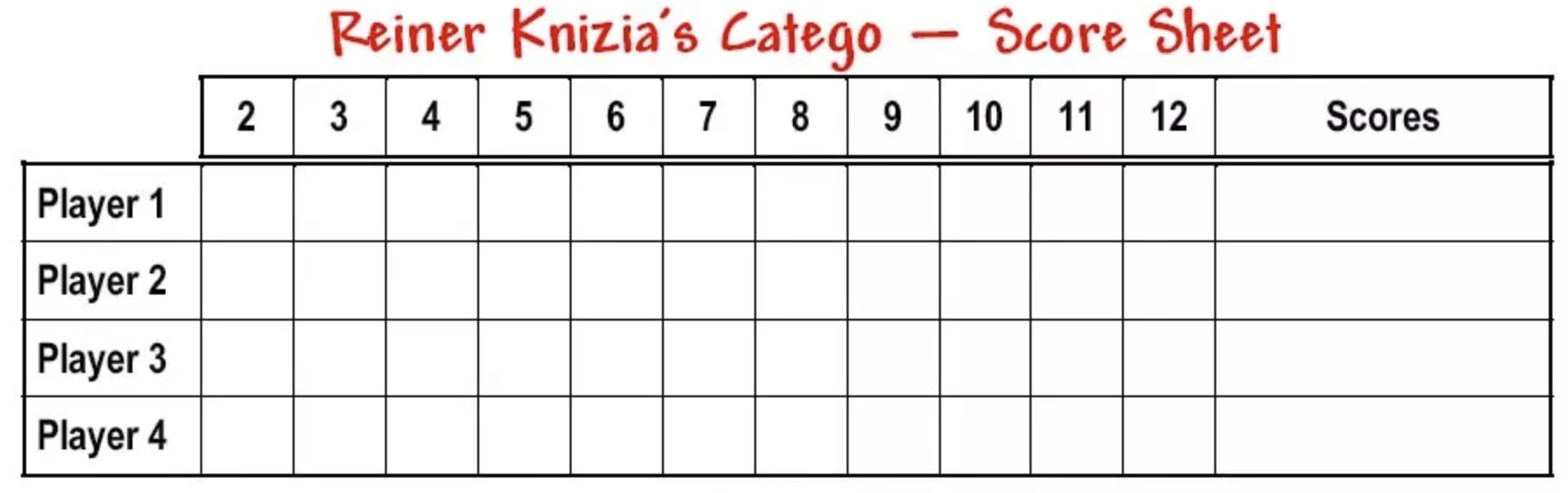
In this game, players take turns, but each only rolls once. The value you roll with the two dice is always your choice to enter into one of the columns, and the player who writes the highest number in a given column wins the value of that column. So, if in the 4-point column, Player 1 writes 7, Player 2 writes 8, Player 3 writes 5, and Player 4 writes 10, then Player 4 wins the column, which will score them 4 points in the final tally.
A funny twist is that ties cancel each other out, so if two players both write 12 in a column, then the laughing third, even with two ones, could win there. The winner, of course, is the one who scores the most points overall.
This game requires more thinking, and there's a bit of strategy involved, but remember, this is ultimately still a game of chance.
Bas (also 2 dice but more laughing)
If we've already found two dice at home and we'd rather laugh than think, then Bas, a simple bluffing game, is our game.
Actually, any number of people can play. The essence is that the two dice are with the player whose turn it is. They roll the dice in such a way that only they can see the result, and then they must state a value they've rolled, but this doesn't have to be true. The next player decides whether to believe it or not. If they do, they ask for the dice and roll themselves.
An important rule is that the stated value must always be higher than the previous one. The two dice always form a two-digit number, with the larger number always coming first, so a 1 and a 3 is always 31; in Bas, you can't roll a 13. If you don't believe what the previous player said, you can challenge them. If they indeed lied, you catch them, and you get a point; if you were wrong and they told the truth, they get the point.
The value table for Bas, in descending order, looks like this: 21, 66, 55, 44, 33, 22, 11, 65, 64, 63, 62, 61, 54, 53, 52, 51, 43, 42, 41, 32, 31.
It doesn't seem too complicated, but it's a very interesting feeling to have no time to think; you see what you rolled and must say something immediately. You can't weigh what would be good to lie about because hesitation gives you away. It's quite easy to get confused in the game, and thus it's quite easy to have a great laugh at ourselves and others alike.
Win, Lose or Banana (played with 3 cards)
In Win, Lose, or Banana, there are only three cards, so it can be made at any time, though only three can play.
You need a Win, a Lose, and a Banana card. Shuffle the cards and distribute them. The Win reveals itself and tries to guess who has the banana. The other two players argue that they are indeed the banana. If Win correctly guesses who the banana is, both Win and the banana get 1 point; if Win guesses Lose, only Lose gets points, and they get two! The game goes up to 6 points, but you can play longer.
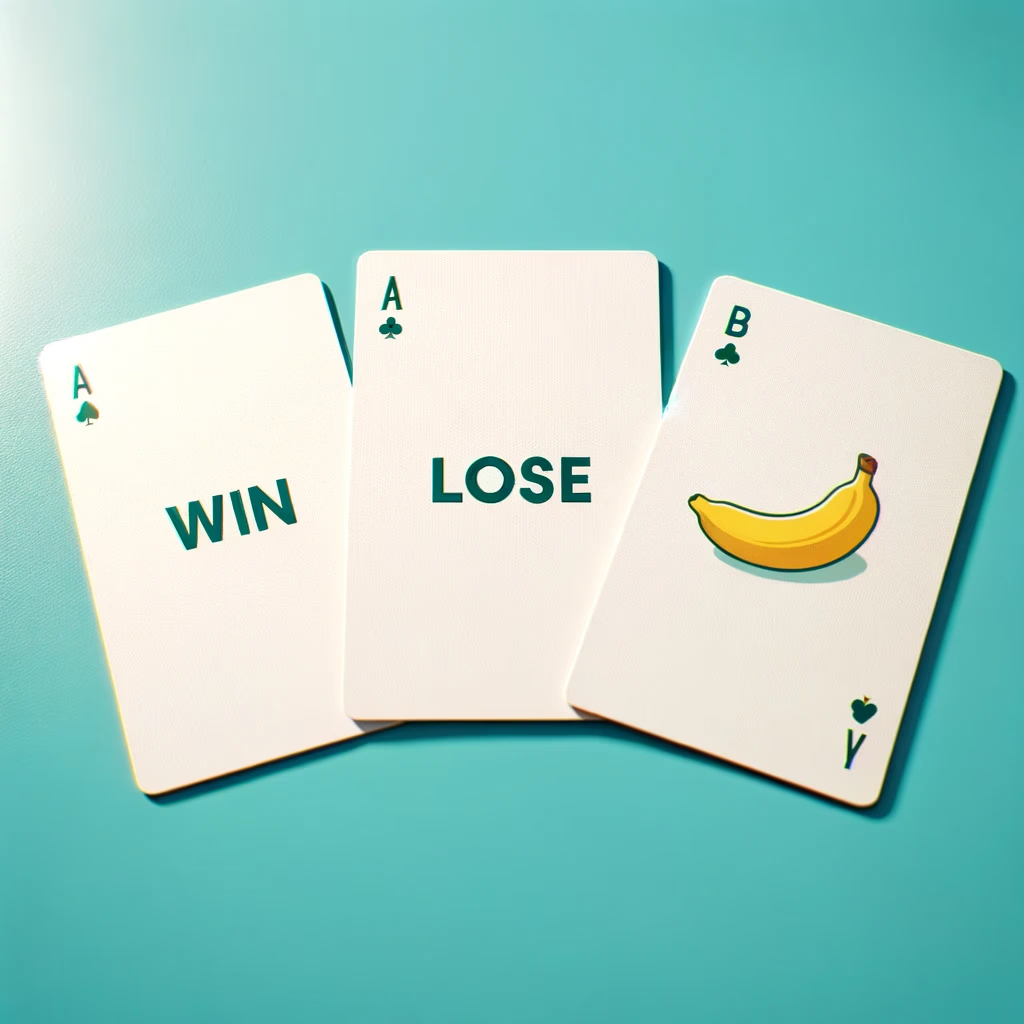
It seems like silly nonsense and well, it is, but observation skills, non-verbal communication, and creativity are quite important, as coming up with new arguments for being the banana doesn't come as quickly as saying, "Look at me, my face is so yellow and my back is curved, just like a banana..."
Liar - 9 cards needed
Two players or two teams can play the game Liar!. It's quite easy to prepare, or you can use appropriate cards from a deck of playing cards. You'll need 9 cards - for example, 3 Kings, 3 Queens, and 3 Jacks, each in the suits of clubs, hearts, and spades.
Shuffle the cards and turn one face down in the center, then deal 4 cards to each player or team. The winner is the one who guesses what the center card is. The team whose turn it is asks a question by placing a card from their hand down and asking how many cards of that suit or rank the opponent has. The opponent must answer, but they don't have to tell the truth, and can lie once during the game. But if they are caught lying, they lose!
At any point instead of asking a question, you can guess what the face-down card in the center is. If you guess correctly, you win; if not, the glory goes to your opponent.
It's a seemingly simple deduction game where you have to be cunning with information, and it gains a new layer when played in teams. I also encountered this game at Jozsef Jesztl's training, and it's very funny when you're trying to secretly discuss with your teammates in front of the opposing team whether to lie or not.
Which game for which situation?
20 friends in a room with plenty of space?
Start with Triangles — it gets everyone moving immediately and creates an unforgettable first impression. Then shift to Mafia or Charades for team play.
20 friends in a room, no space to move?
Go with Contact — it works seated and keeps a large group engaged. Follow up with Two Truths and a Lie or Never Have I Ever.
Just two of you?
Mate's classic go-to: 20 Questions. Also try Ghost for a vocabulary duel or Black, White, Yes, No for rapid-fire fun.
In a car or on a train?
20 Questions is always a solid pick. If you're four people, Word Bridge will keep you entertained for the whole ride.
People don't know each other well?
Two Truths and a Lie is one of the best icebreakers — you choose what to share, and you learn what others assume about you. Follow up with Would You Rather to keep the conversation going.
Need to energize the group?
Ninja, Simon Says, or Evolution, or a quick Rock-Paper-Scissors tournament will get everyone moving and laughing in under a minute.
Tips for better equipment-free games
-
1.
Explain rules in 30 seconds or less. Equipment-free games are exciting precisely because they're simple. If you can't explain the rules in half a minute, the energy drops. For more on this, see our guide on how to explain game rules effectively.
-
2.
Start simple, go deeper. Begin with a word chain before jumping to Word Bridge. Open with Simon Says before introducing Triangles. Let people ease in.
-
3.
Read the room. Games that involve touch (Ninja), sharing personal information (Two Truths), or closing your eyes can be uncomfortable for some people. A simple word chain will never cause awkward moments — but it also won't go as deep. Balance accordingly.
-
4.
Switch before it gets stale. Most equipment-free games are best in short bursts. Play 2-3 rounds, then switch. The variety keeps the energy up.
-
5.
Match the game to the group size. Contact shines with 5-8 people; it falls apart with 3. Charades needs at least 4 for teams. Check the player counts in the reference table above.
Additional tip
Playing with adults? Right?!
I'm glad I'm not alone in this and that you're also interested in what can spice up friendly gatherings. The games collected above are all exciting and interesting, but really, it could be anything else too; the main thing is to accept that as adults, it is not only possible but also worthwhile to play.
As a young adult, it was a huge experience for me to discover that socializing through games, as a communal experience, as a framework for making friends, can add so much to my life. And today, I always have 1-2 games with me, or 1-2 game components that can be played with, not to mention hundreds of rules in my head.
And of course, there's always someone who's a bit reluctant, and that's okay, even good. There might even be someone who really doesn't like playing, but if we love it, then let's be the driving force behind it and find even better games, sometimes even those that require nothing or almost nothing. And let the fun begin!
Frequently asked questions
Frequently Asked Questions
Related Reading
No spam, ever. Unsubscribe anytime.
Spread the Fun of Learning!
Love our content? Show your support by sharing our page with your friends and help us inspire more families and educators with the joy of learning through play! Your shares truly make a difference. Thank you for being a wonderful part of our community!