Pebble
Huddle
Slide your pebbles across the leaves, capture the opponent's scattered pieces, and be the first to gather your flock into one connected huddle.
A game by József Jesztl
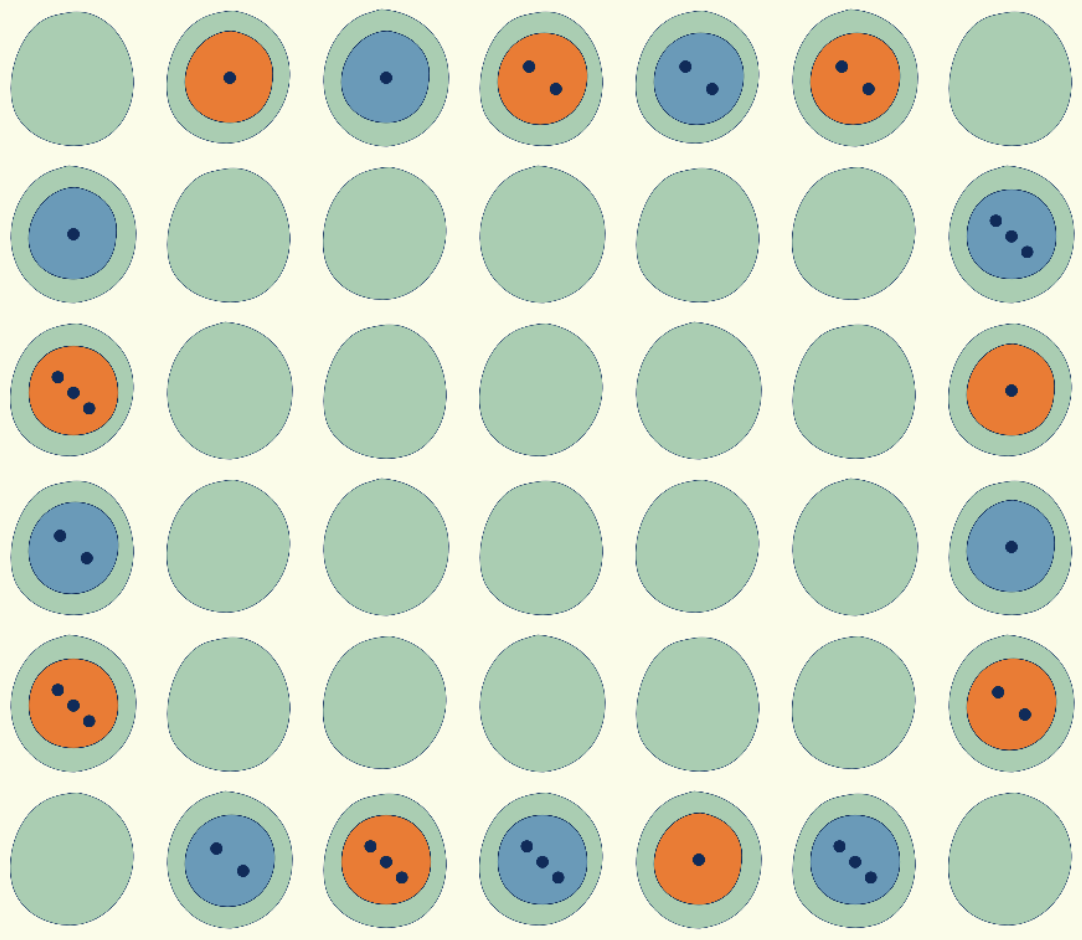
Try it online — then print and play with your kids
Pebble Huddle is the digital version of a printable board game by József Jesztl. The original lives on paper, designed to be cut out and played around a real table by families and classrooms.
We built this online version as a friendly practice ground. Play a few rounds against the computer, get comfortable with the moves, then download and print the game to play it with your kids at home. You'll already know the rules, so you can guide them confidently — turning a screen-time session into a shared, screen-free learning moment.
Two players. Nine pebbles each. First to gather their flock into one connected huddle wins.
Why play Pebble Huddle
A short game with a long shadow — what teachers, parents, and curious kids find inside.
Born in a classroom
This isn't a game from a corporate boardroom. It came from a teacher's notebook — real kids tested it, real teachers refined it, and only then did it land on paper.
Built for teaching
The rules fit on one page; the lessons run much deeper. A downloadable teacher's guide unpacks the pedagogy behind every move, ready for the classroom.
Made to be fair
Asymmetric rules let kids of different ages or skill levels play together without anyone feeling shortchanged. A six-year-old and an adult can have a real game.
Sharpens real skills
Spatial reasoning, planning ahead, weighing trade-offs — the kind of strategic thinking that shows up in maths, in writing, and in everyday choices.
Worth talking about
Played, then discussed. What worked? What didn't? What would we try next time? A short board game turns into a long conversation.
Simple rules, deep play
Picked up in a minute, mulled over for years. Even after twenty games the board still hides a sharper line waiting to be found.
How to play
A quick read and you're ready for the kitchen table.
The goal: huddle your pebbles
Be the first to gather all your remaining pebbles into a single connected group — a "huddle." Two pebbles count as connected only when they sit on cells that share an edge (left, right, up, or down). Touching diagonally doesn't count. If a player has only one pebble left, they have already won — a single pebble is itself a complete huddle.
Move by the dots
Each pebble can move as many cells per turn as the dots painted on it — one, two, or three. A 2- or 3-dot pebble may also move fewer cells than its maximum. Pebbles move in any of the eight directions (straight or diagonal). You can hop over your own pebbles; opponent pebbles block your path.
Capture, but carefully
Land exactly on an opponent's pebble — using your full number of dots in one move — to capture it. A 1-dot pebble can only capture at exactly 1 cell away, a 2-dot at exactly 2 cells, and a 3-dot at exactly 3 cells. Directions and jumping rules are the same as for movement: you can hop over your own pebbles, but not the opponent's.
What winning looks like
Orange's remaining pebbles form one connected cluster — every orange pebble touches at least one other. Blue's pieces are still split across the board, so orange wins the round.
The shape of the huddle doesn't matter; all that counts is that every piece is connected.
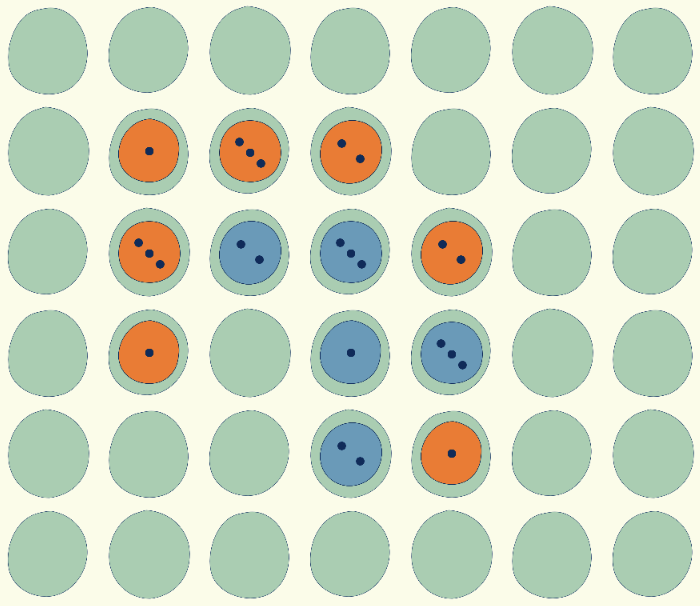
Born on paper. Now online, so you can bring it home.
Pebble Huddle (Katicatülekedés) first appeared in 2019 in Jól játszani, a book by József Jesztl and Máté Lencse. The authors' goal was to show how to learn board games, how to explain rules, and how players of different abilities can enjoy a game together. They demonstrate this through seven original board game designs, showing how games can be made asymmetric and how advantages can be given at different levels and in different ways.
The book is slowly running out of copies, but it sits on many family and teacher shelves, helping people play well together. (If you happen to run a publishing house and you're reading this — do get in touch at [email protected] — we'd love an international edition.)
By publishing the games online, our goal is to make them more widely known. For each game we have written a detailed, competency-developing teaching guide — far more comprehensive than the book — available for download on our site, because we believe in the educational value of board games and the motivating power of learning through play.
See the book on pagony.hu →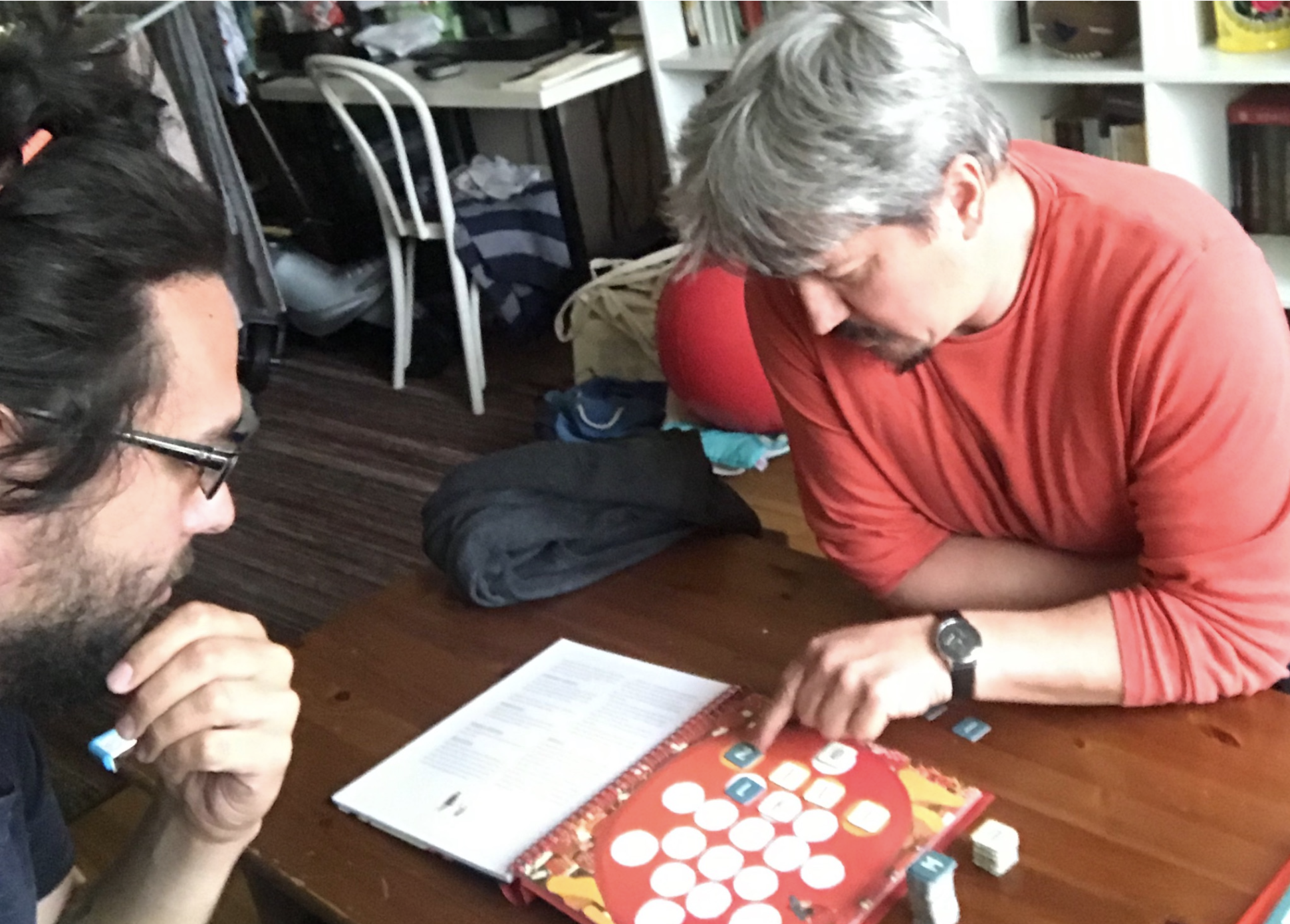
The happy authors, playing with their complimentary copy for the first time in 2019.