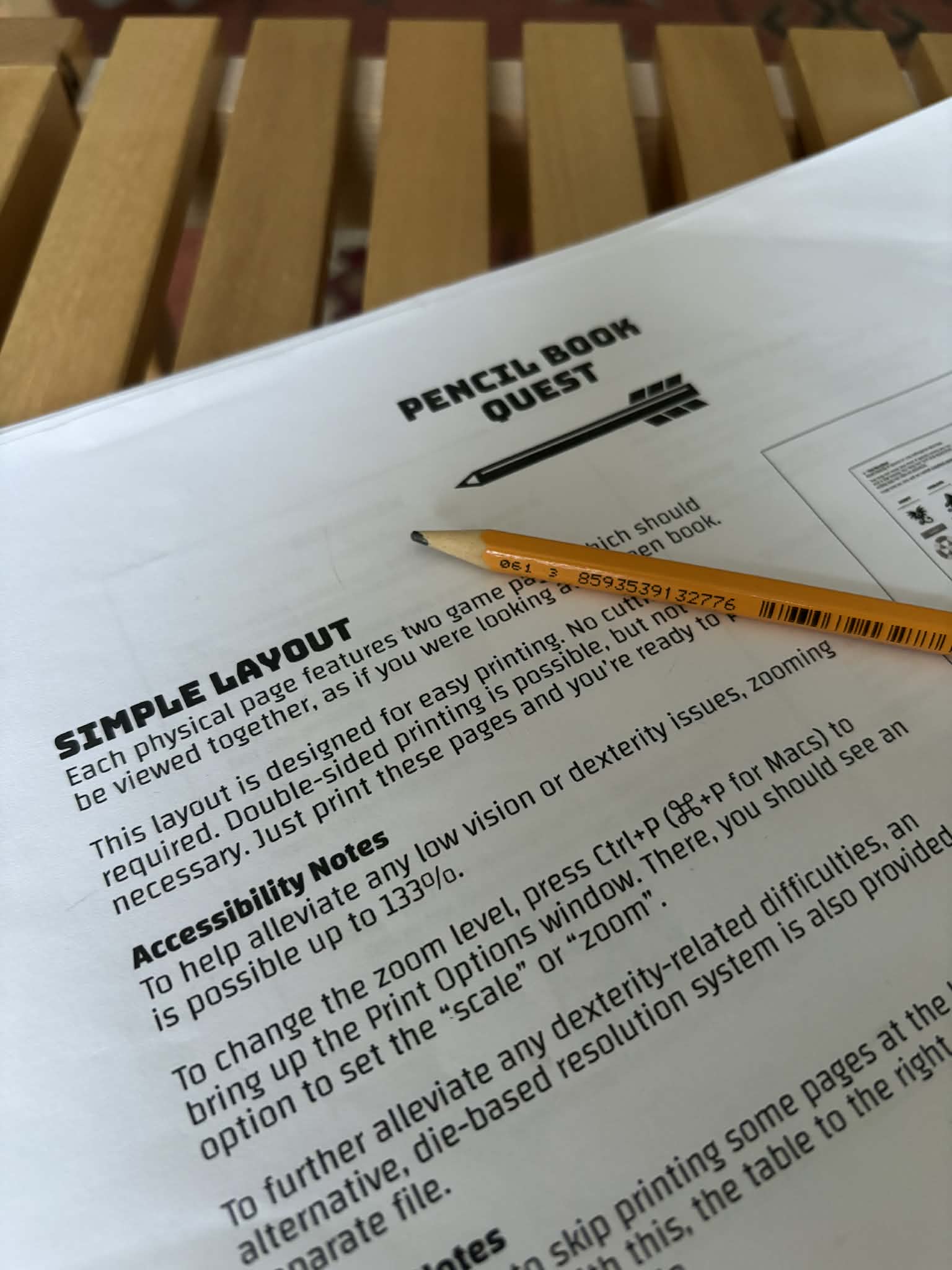
I’m specifically on the lookout for solo-playable, print-and-play games that feel unique or clever in some way, and that’s how I came across the Pencil Book Quest Kickstarter campaign. (It’s a joy to see that more than 2,700 people backed the game!) When I first saw it, my immediate reaction was that this was something I could easily have made myself. And whenever I have that feeling—when a bit of professional jealousy creeps in—I usually end up discovering a game that I really like. This time was no exception.
I bought the print-and-play version, but there’s also a nicely produced physical edition of the game; it’s a matter of personal taste, so it’s worth taking a look around on the publisher’s website as well.
Review
Print and Play
Since it’s a booklet, it naturally lends itself to easy printing and thus to the print-and-play format. That said, it could still have required a huge amount of components—but it doesn’t, which makes it fair to say that this is an ideal print-and-play game. Of course, this way it’s not quite as pretty, and you don’t get the special pencil either, but for me the gameplay experience feels just as complete. The files are simple and clear. You don’t need to print the entire book right away; you can print it gradually as you progress—at least, that’s how I did it.
Gameplay
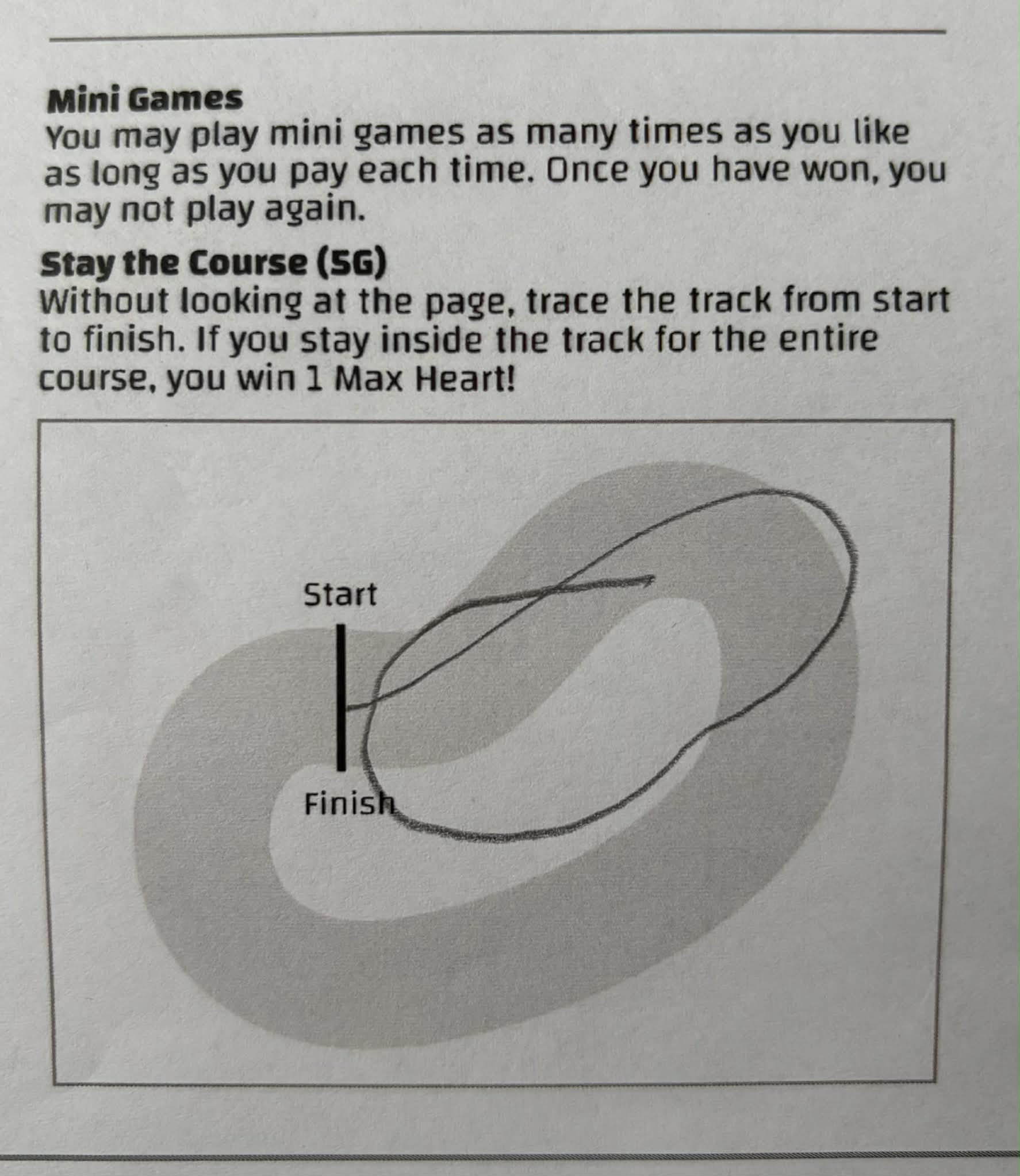
This is an adventure game. Not in the classic sense, since the story isn’t really the focus, but you complete more and more stages and adventures while defeating monsters, acquiring weapons and items, and progressing toward your goals. What really grabbed me about the game is its unique combat system, which fits the format perfectly and uses dexterity-based elements. You place your pencil on a point, close your eyes, and then try to tap a target area slightly away from it. The monster will die no matter what, but how much damage you take—and whether you trigger the monster’s ability—depends on your aim.
Landing a perfect hit is an incredible experience, easily the biggest flow moment in the game. I really love clever ideas I’ve never seen before, and this is exactly that. Movement on the maps is also handled in a clean, elegant way, and the overall level design clearly shows a lot of thought. The game isn’t easy either—I’ve already died several times—but that’s absolutely part of the fun in a game like this. Extra bonus points for the mini-games, even if I didn’t do particularly well at them, as you can see in the image below.
Illustrations
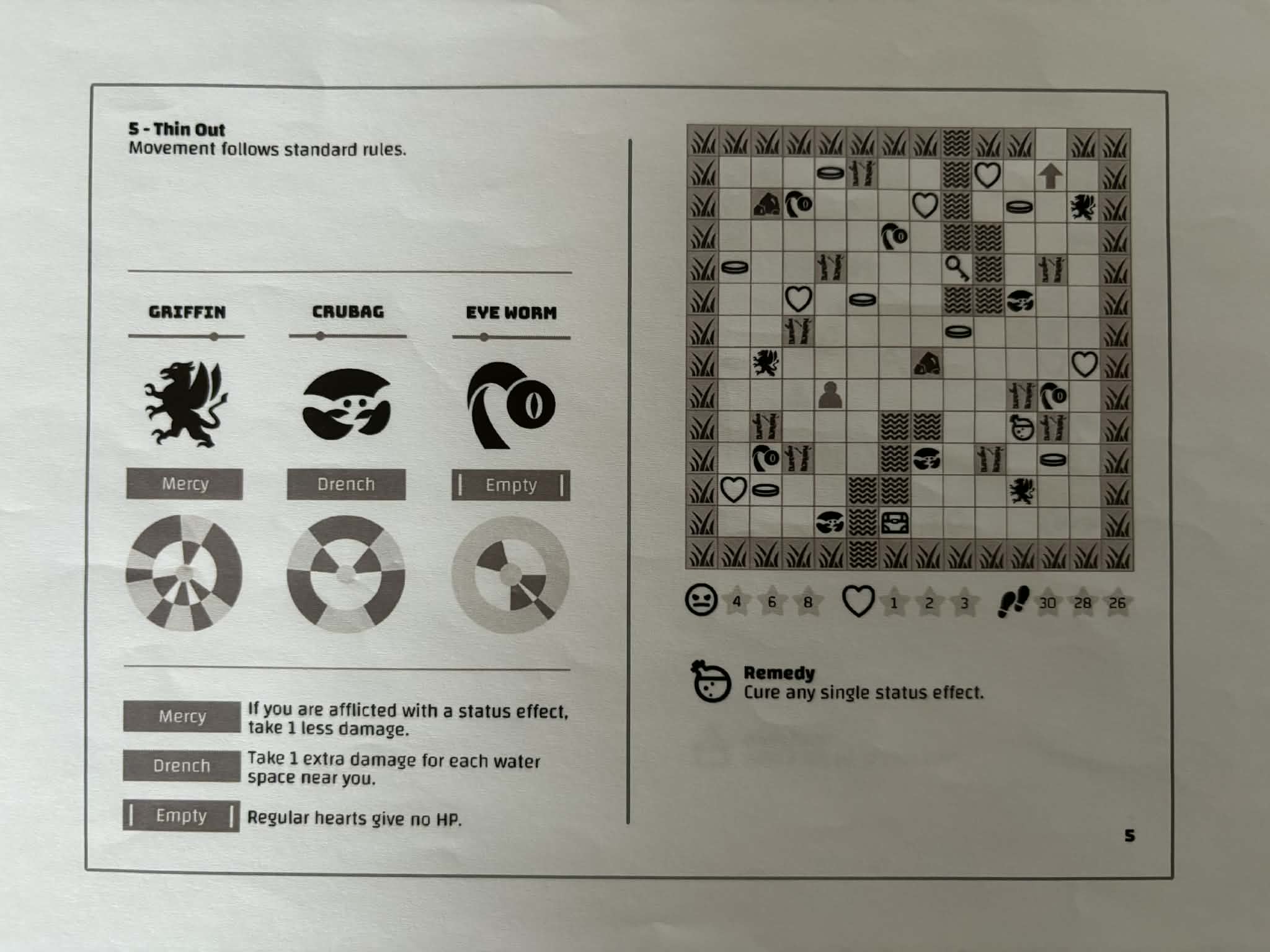
I particularly like this restrained style. The typography is nice, the layout is solid, the levels aren’t overdecorated—everything is clean, functional, and perfectly supports playability. From a print-and-play perspective this approach works especially well, but I like it regardless.
Overall Impression
Of course, it happens that no matter how thoroughly you research something, and no matter how many hundreds of games’ worth of experience you have, a choice can still end in disappointment. Over time, though, it becomes more and more common that you know what you’re choosing—and you’re happy with it. That’s exactly how I feel now, because I got exactly what I expected, or perhaps even a little more!
I like the structure of the adventures, the way the game develops, and the core dexterity-based mechanic, which brings in a bit of a push-your-luck feel—while still genuinely depending on your own actions. I also enjoy the fact that wandering around the map is quite a serious logical challenge: you’re essentially programming your route in order to perform as well as possible. This is another element I particularly appreciate in the game as an educator.
I can wholeheartedly recommend it to colleagues and parents because of its programming and logic aspects, but it would also fit perfectly into our list of games that develop reading skills, as it constantly encourages text comprehension, almost completely unnoticed. Personally, I’d say it’s playable from around age 10, even if a 14+ recommendation may be justified due to the theme. (I myself made extensive use of Steve Jackson and Ian Livingstone’s Fighting Fantasy books in education as well.)