The rules, quickly and simply
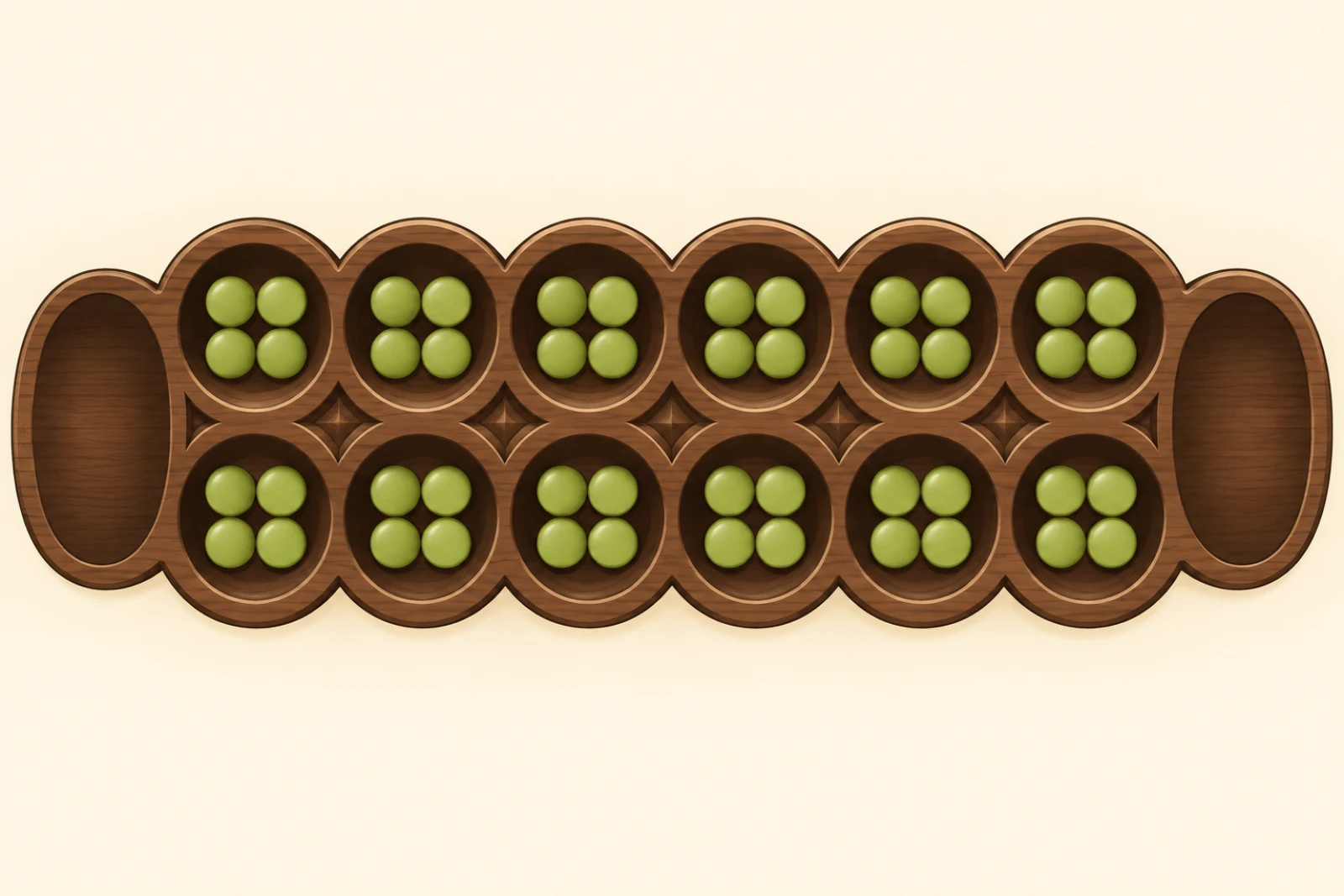
Let’s take a quick look at how to play Kalah. It is a two-player abstract strategy game. Each player has six small pits, with four stones in each, plus a store of their own on the right-hand side. The player who collects more stones in their store wins.
Play moves counterclockwise. On your turn, choose one of your own pits, pick up all the stones in it — you may not leave any behind — and sow them one by one into the following pits. You also place one stone in your own store when you pass it. If you still have stones in your hand after that, continue into your opponent’s pits. One important exception: you always skip your opponent’s store. Even if a pit holds so many stones that you make a full circuit of the board, their store is still skipped.
Three more rules add colour and depth to the game:
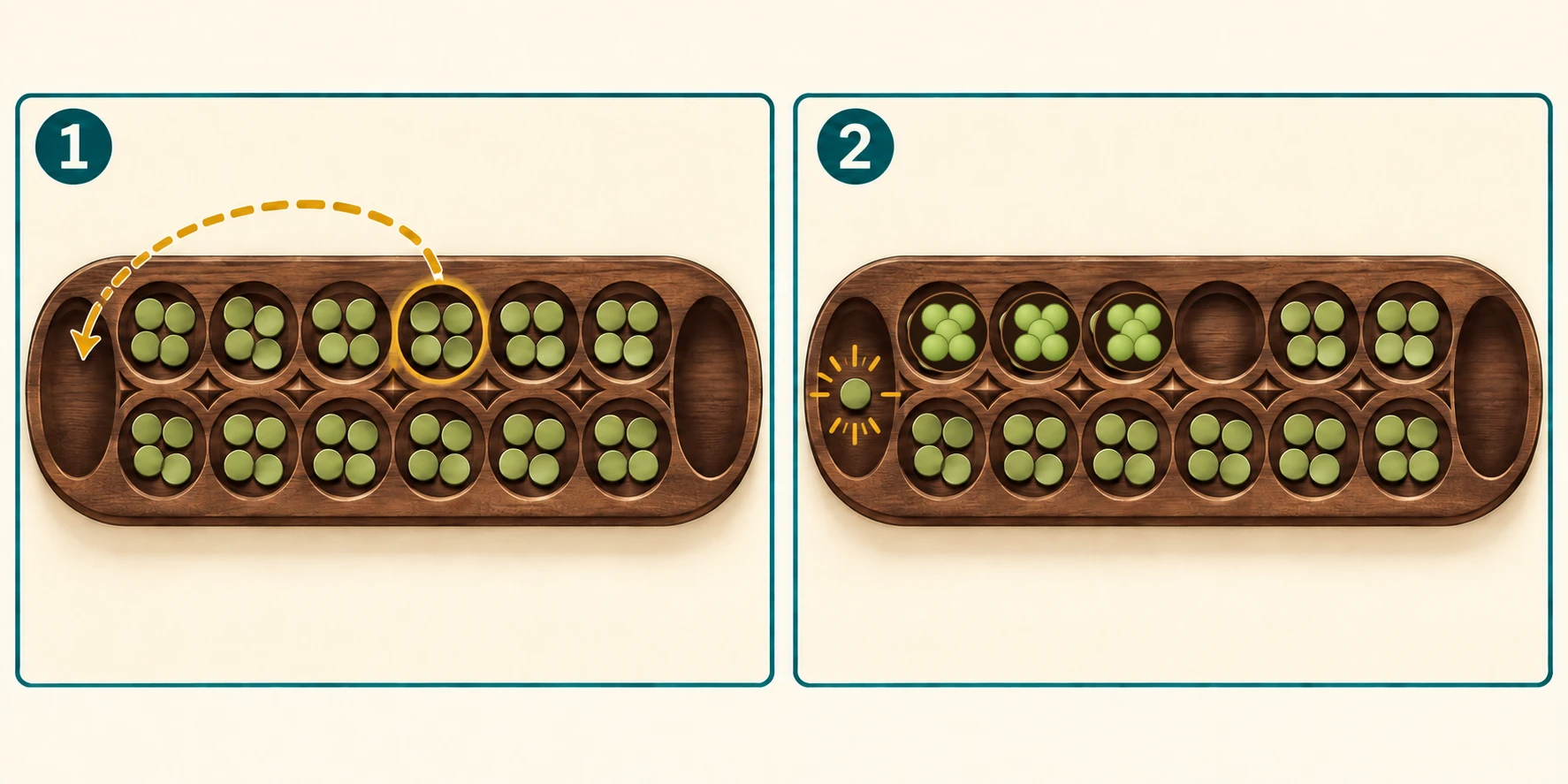
- Extra turn: if the last stone in your hand lands in your own store, you play again. At the beginning of the game, for example, it is worth choosing the pit four steps away from your store: your fourth and final stone lands in the store, and you immediately get another move.
- Capture: if your last stone lands in an empty pit on your own side, you capture the stones in the directly opposite pit. Move both the capturing stone and your opponent’s stones into your store. Your turn then ends.
- End of the game: the game ends as soon as one player has no stones left in any of their pits. The other player moves all remaining stones on their side into their store. Whoever has collected more stones wins.
Mancala, Kalah or Kalaha?
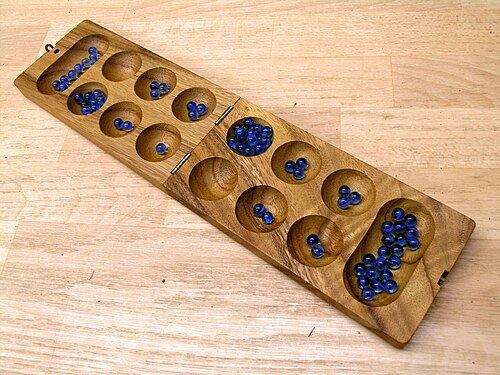
Any of them, really. Mancala is a family of games played around the world, under many names and with many different rules. Even the boards vary: there are one-row and two-row Mancala games.
I usually say that instead of arguing over the “original” rule, we should play. If you cannot agree about a particular detail, try it one way, then try it the other way. The heart of it is the experience of playing. To borrow an example from a completely different game, most groups eventually agree on which of the many Uno rules they actually use.
Mancala is a fascinating game family, and it has influenced modern board games too. The best-known example is Five Tribes. We also have our own playable variation, Lily Hop.
Examples that make the rules easier to see
Starting position
Put four stones in every pit. Once you have played plenty of games this way, you can try five or six stones per pit. That small change gives you a noticeably different game.
Extra turns
If you earn another move, you keep control of the board and can send more stones into your store. It is well worth looking for these opportunities. There is one right from the opening position: move from the fourth pit away from your store, and your final stone lands in the store.
Capturing
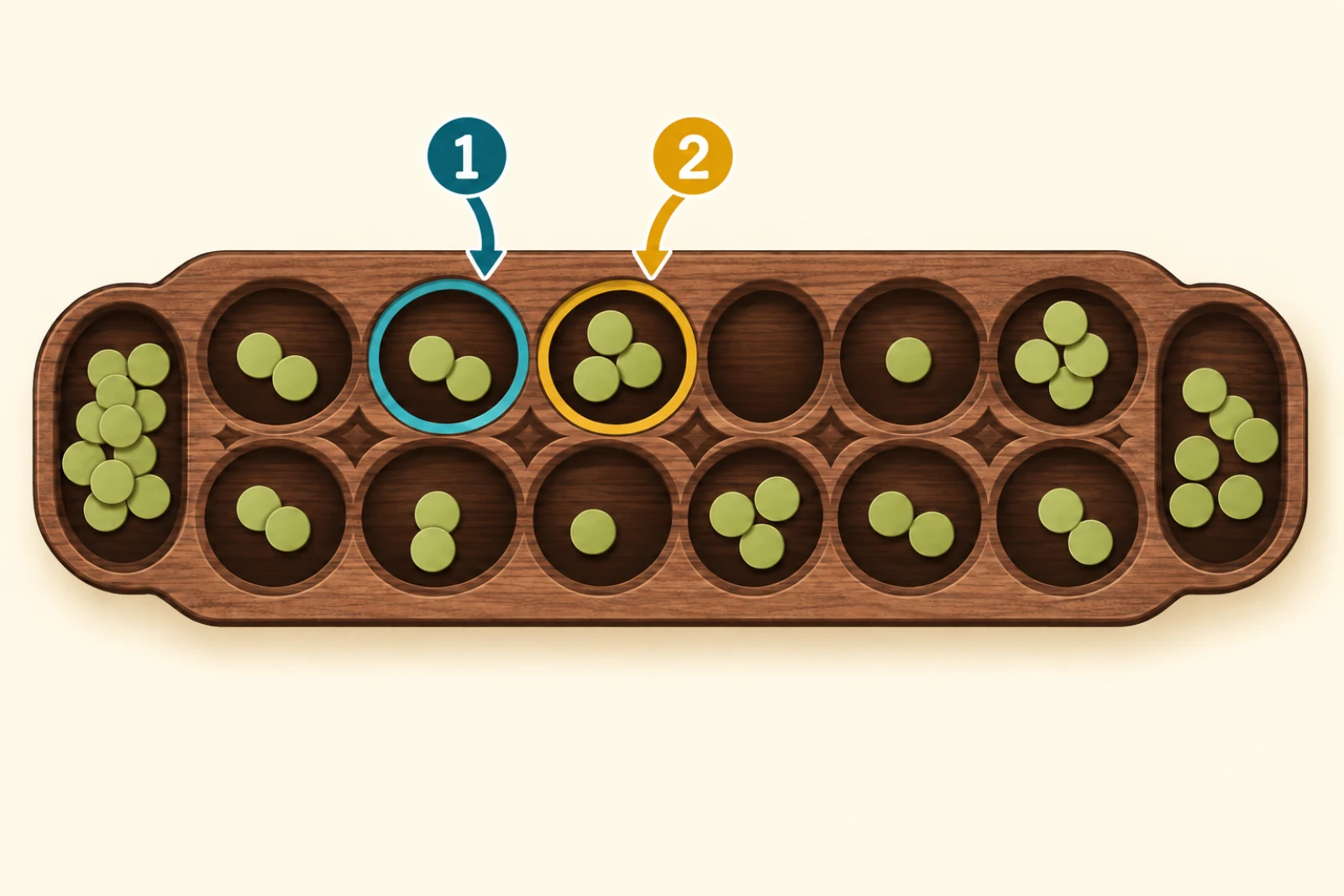
Captures demand attention. Taking several opposing stones increases your score while also reducing your opponent’s choices. Imagine that the top player has left five stones exposed opposite an empty pit. If the bottom player’s last stone lands in that empty pit, they capture all five opposing stones — along with the stone that made the capture — and place them in their store.
The order of extra turns
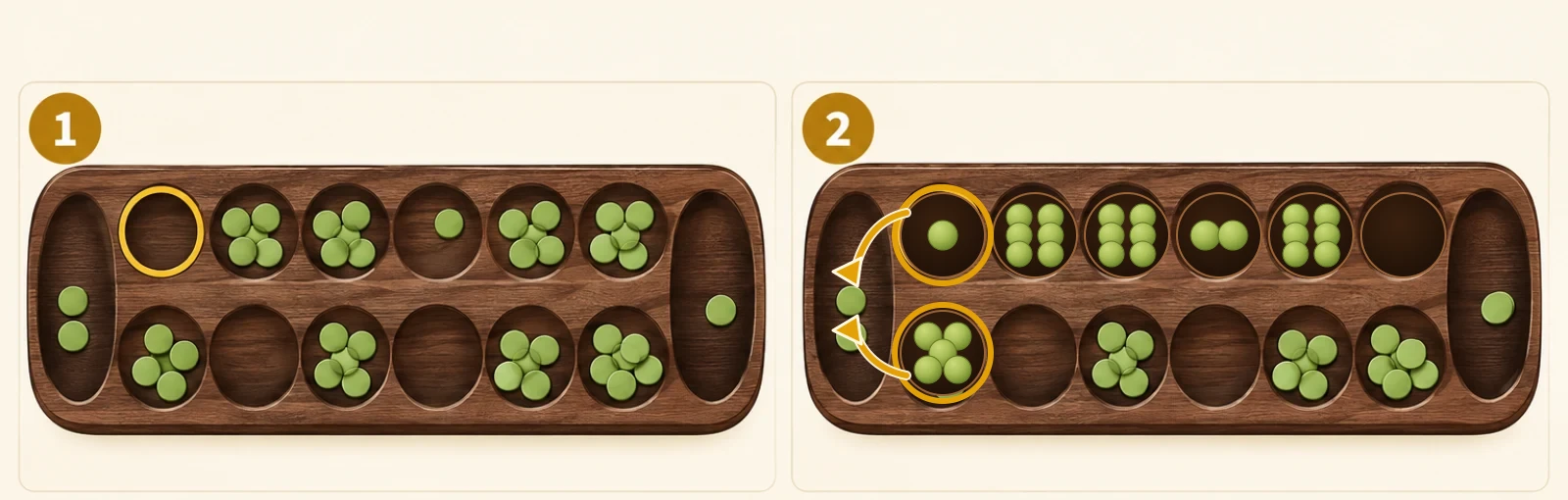
I will whisper this part only to you, dear parents and teachers: leave children the joy of discovering it for themselves. The order of your moves matters. If one pit holds three stones and another holds two, playing the three-stone pit first may earn an extra turn but spoil the opportunity offered by the other pit. Play the two-stone pit first and the three-stone pit second, and you may be able to move three times in a row.
The end of the game
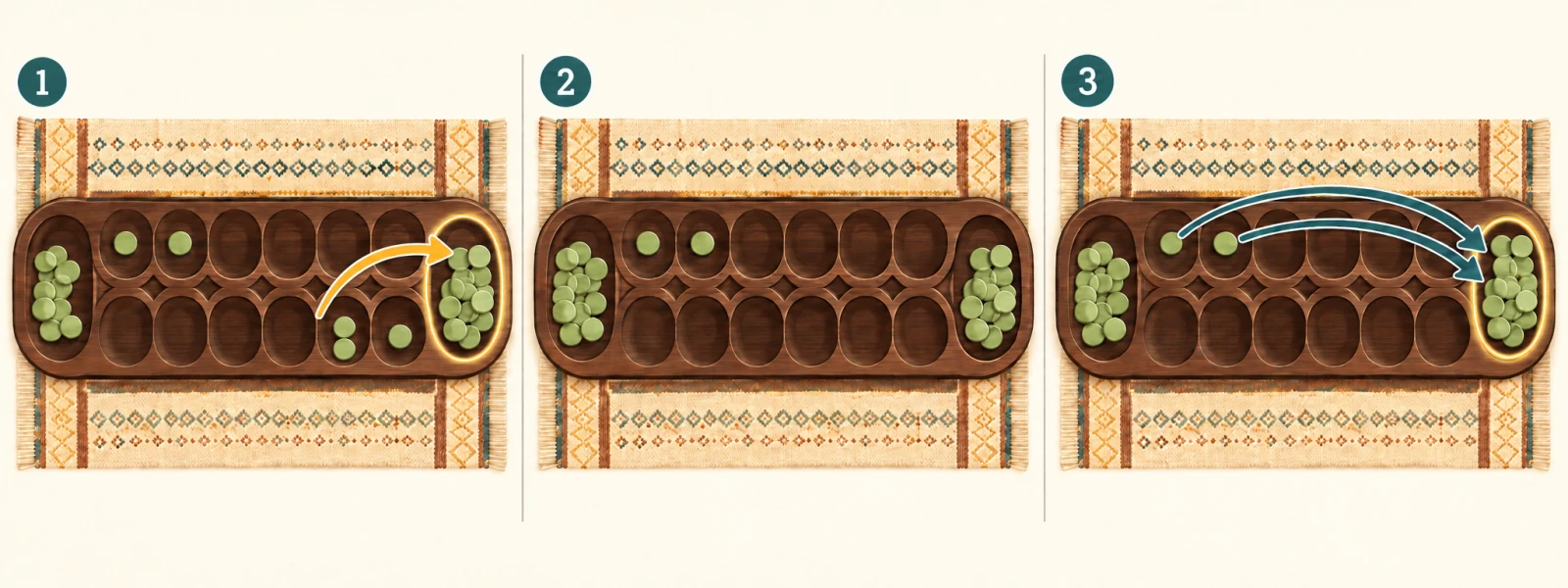
Suppose the bottom player is to move and every possible sequence empties their side. The game ends immediately, and that player collects all stones still left in the opponent’s pits.
Counting the result
A quick way to count is to place stones from your store back into the six pits, four at a time. The stones left over show the winning margin.
How to teach Kalah to children
You can teach a game well when you have done more than read its rules: you have played it several times. It helps if you love it, too. Now that you know the rules, try Kalah online or play with your partner, a friend, or a colleague. Then you are ready to teach.
Stick to the rules. We do not teach tactics and strategy, because that takes away the joy of discovery and does not support children in becoming effective, independent learners. The basic rules are not difficult, but prepare two or three concrete examples for extra turns and captures. And remember: we teach rules with the game set up in front of us, not as an abstract lecture.
Kalah supports fine motor skills, counting, estimation, comparing quantities, recognising numerical patterns, planning, and adapting plans flexibly. But that does not mean we need to turn a Kalah match into a maths lesson. Play often, and let the game do its work.
From Kalah to Lily Hop
Kalah is one of my favourite classic two-player abstract games. I play it often with children and love its central mechanism. So when József Jesztl and I wrote our book Jól játszani (Playing Well), it was obvious that the book should include a Kalah variation.
In my version, every pit starts with just one stone, so the position builds more slowly. There are also stones belonging to you and stones belonging to your opponent. You may move only from a pit in which your colour is in the majority, and you have more than one possible direction of play. Whenever a pit reaches five stones, the player whose colour is in the majority wins the entire contents of that pit. There are captures, but no extra turns.
I think Lily Hop is an exciting variation you can play online for free. It was never meant to be better than the original — only different. If you enjoy it, we have also created teaching materials that take the game further.