It is easy to turn a good game into a bad exercise
In Hungary, chess is the “smart game”. There are many genuinely good chess programmes, even for very young children. Although they tend to emphasise skill development, parents and children often focus just as strongly on becoming better at the game. Competitions matter. Measuring yourself against others matters. That means studying openings, analysing endgames, training, and going deeper. For me, somewhere in that process, the joy of play and the focus on broader development can disappear.
This is not a criticism of chess. Still, I have seen plenty of very poor games between children — and I am no great chess expert — that lasted a very long time.
To me, chess is only one game among many. This summer, a boy sat down with me at a camp. I offered him a few games, but he dismissed all of them. Why were we not playing chess instead? He was very good, he went to chess classes, and so on. Throughout our game, I kept thinking about how many exciting challenges I could have offered him in those same twenty minutes. Instead, we played an unremarkable chess game until he missed a long diagonal and walked into my transparent three-move checkmate. By then he had been trash-talking for several minutes because he had captured my queen.
At talks and training sessions, I often ask who can play chess. Very few hands go up. Then I ask who knows the rules. Almost everyone raises a hand. And that is exactly the point. Learning to play chess takes a long time. Success comes slowly, and the game is not for everyone. Children do not develop logical thinking and problem-solving simply because they play chess. They develop these abilities by playing two-player abstract games — and there are many games with a much lower threshold. We collected plenty of them in our guide to abstract games beyond chess, and we will meet some of them here too.
Nine Men’s Morris and Tic-Tac-Toe are still quite common among Hungarian children, but there are games with an even lower threshold. It is worth finding them and starting there, so we lose fewer children at the very beginning. Abstract games are too valuable to let that happen. Left to myself, I would teach everyone Go immediately. I think it is the most beautiful and deepest game, and I love it. But the fact that I love it cannot be the deciding factor. I cannot ask a child who never plays abstract games — and may not care about them at all — to explore that kind of depth straight away. We can turn a match around even from complete resistance. Let us see how.
Which game should you choose?
There are a few things worth looking for:
- Rules you can explain in one or two minutes. This matters especially while you are still building a culture of play. You need practice explaining rules, and children need practice understanding them. Choose a game they can grasp almost immediately. A simple Nim variation is a perfect example.
- A short playing time — preferably under five minutes. That lets you fit four or five games into fifteen or twenty minutes. This is extremely important for learning, and we will soon see why.
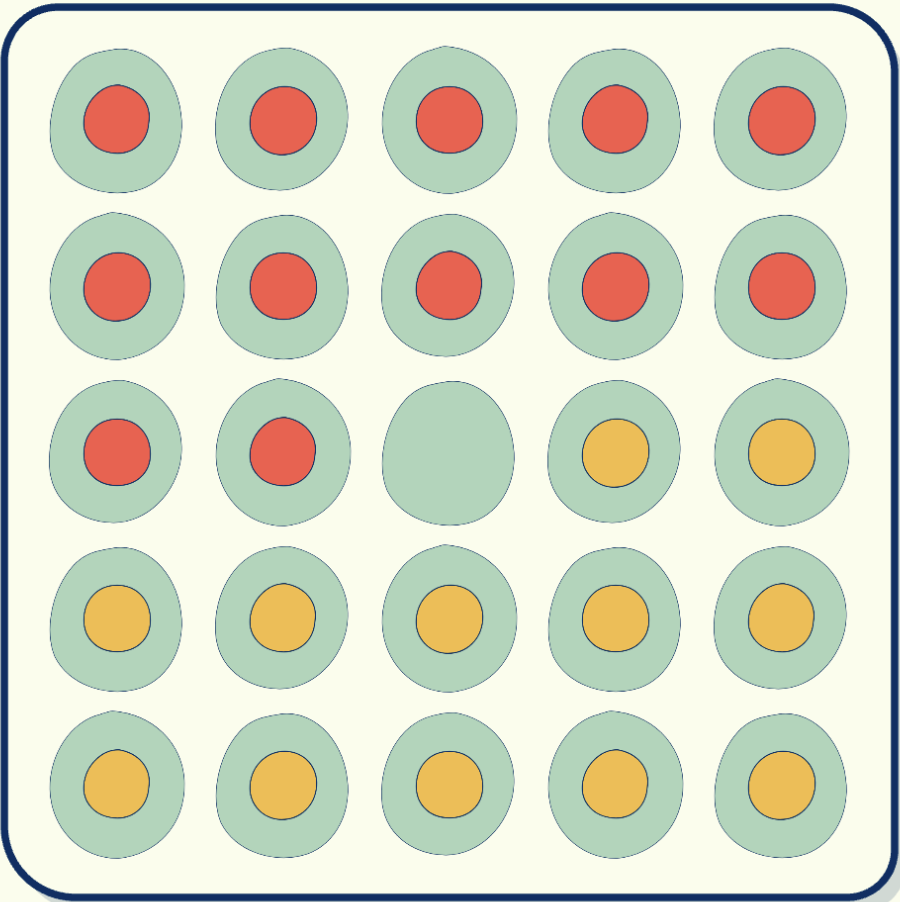
- Consequences that become visible quickly. If we start with Lahti instead of International Checkers, children can fit many games into a short period, understand a checkers-like structure quickly, and see the consequences of many decisions. There is a Go proverb: lose your first thousand games quickly. When a game lasts one or two minutes, that can happen much faster. We learn from our own mistakes, our opponent’s mistakes, and the good moves made by a parent or teacher.
- Replayability. We understand a structure by meeting it again and again. Simple, quick games make this easy. Losing immediately becomes less overwhelming, and the experience of success arrives much sooner. Both matter.
- Simple equipment. For parents and educators, it is valuable when a small, simple game also needs only a small, simple set. You can make enough copies for a whole class out of almost anything. It also sends an important message to children: meaningful, genuine play does not require large and expensive objects. We are especially fond of games you can play without any equipment at all.
How should you introduce a new game?
By playing it. We should reach the game itself quickly, which is another reason to choose a low threshold. Give a quick, compact explanation, use a simple structure, and start. Play several games in a row. In a classroom, change partners more than once. This soon reveals whether everyone understands the rules: if two players interpret something differently, they will disagree and expose the misunderstanding. There are no pairs who finish early, either. We simply say: start another game. No dead time, no boredom.
Do not analyse the game for them, and do not teach tactics or strategy. Let children make mistakes. Our job is to create and maintain the play situation — nothing more. The game will teach them how to play it well. Let children practise learning effectively and independently. If they ask an analytical question, we do not need to reject it, but we should guide them towards finding the answer instead of handing over a recipe:
Child: That was not a good move, was it?
Adult: Why do you think so?
Child: Because they captured my piece.
Adult: Is that a problem?
Child: Yes. It weakened this side, and I lost.
Adult: Could another move have prevented it?
Child: I don’t know. Maybe?
Adult: Try it. Can you rebuild the position? Take a look. Or start a new game, and if a similar position appears, feel free to try something different.
I hope you can feel how different this process is from simply telling the child what they should have played.
At home or in a small club, I strongly recommend playing yourself. Your participation can make the whole educational situation far more valuable. None of the earlier principles change, but your presence inside the games means a great deal.
One possible path from ages 4 to 12
We have already explored this in our main article about abstract games. There is one important addition: this is not simply an age question. Because of my work, my daughter had already played many abstract games by preschool. But if this world — or board gaming itself — is new to someone, it is worth beginning at the start of the path even after age ten. This is not about intelligence. These games are not silly; they are simple.
| Stage | Age guide | Games | Why these |
|---|---|---|---|
| First moves | 4–6 | Tic-Tac-Toe, Nim, Lahti, Neutron | A handful of pebbles, a tiny board, rules in a minute — and six to eight rounds fit into fifteen minutes. |
| Building confidence | 6–9 | Kalah, Gomoku, Quarto, Quoridor, Blokus, Santorini | Familiar ideas with one new twist at a time; short games with real decisions. |
| Going deep | 9+ | International Checkers, Go (9×9), Onitama, Hive, Azul, Twixt, YINSH | Depth that rewards practice — these games can stay with you for decades. |
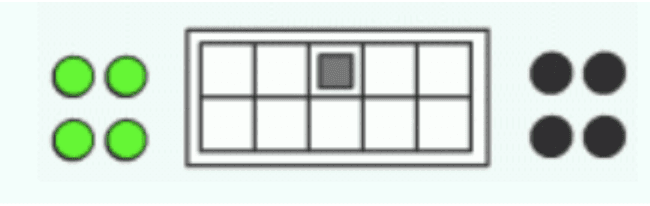
Take the ages loosely. What I recommend first depends on many things, but if I can choose, I begin with Nim, Lahti, and Neutron: a few pebbles, perhaps a tiny board, and you still have to think. They show beautifully what abstract games are about, yet they can be learned and cracked quickly.
The rulebook is rarely the obstacle. Abstract games often have simpler rules than board games marketed for young children. The challenge is not understanding the rules, but operating what grows out of them. That is why, at the beginning, I mainly watch the length. Mancala is not especially short, and I have still taught it to preschoolers many times — but Nim or Neutron are safer first choices.
What should you ask after the game?
“How did you like it?” Seriously. It is a good way to start a conversation. I do not like making children analyse games on command. I want to know how they felt. If the conversation moves towards professional or strategic analysis, I follow the attitude shown in the dialogue above: guide them, but let the insight come from them.
When a child says for the first time that a game was good — or that they enjoyed the situation — despite losing, something very valuable has happened from an educational point of view.
Handling different skill levels
At board game education workshops, I often begin with a question: “Who lets children win?” Most hands go up. People want to avoid conflict, provide a sense of achievement, and protect motivation. But a genuine struggle for victory can support these aims too. Rather than handing children a win without a fight, we can model effort by fighting honestly for our own.
When an adult plays a child who has received a substantial advantage, the adult can demonstrate both skill and determination. The struggle becomes a lesson: the child sees what serious effort looks like, while both players still have a reason to try their best.
That is the point of creative handicapping: to equalise chances without faking the game. Go even marks specific places for handicap stones. It can feel strange at first, but the principle is essential. Everyone should be able to play with full commitment. You can find practical examples in our full guide to giving advantages in board games.
What does the research say — and what does it not say?
There is a professional reason why strategy games feel so rich. A child makes a decision, sees what follows from it, forms a new idea, and tries again. The University of Cambridge’s NRICH project describes strategy games as “low threshold, high ceiling” tasks: children can enter them easily, while the search for a winning strategy creates room for logical thinking, hypotheses, and communication. A classroom study indexed by ERIC similarly highlights abstract strategy games as a setting in which mathematical reasoning can emerge through sustained play and carefully chosen prompts.
But this still does not justify saying that a particular game will make every child smarter. A 2026 systematic review and meta-analysis examined board games and executive functions across the lifespan. It found some promising, specific effects — including verbal short-term memory in children in the systematic review and visuospatial short-term memory in kindergarten in the meta-analysis — but the studies were varied, and some analyses showed high heterogeneity. The authors’ overall conclusion is cautious: the evidence is not yet strong enough for a broad recommendation that board games improve executive functions.
That caution fits my experience. A game can create a powerful developmental situation when it suits the child, the group, and the adult’s way of being present. Nothing is automatic. So let us make smaller, more honest claims: children make decisions, test ideas, adapt plans, and experience the consequences of their choices while playing. Those are valuable opportunities. What a particular child takes from them is something we need to observe, not promise in advance.
Two ready-to-use mini sessions
Kalah with the family
- Craft first: if you do not own a Kalah set, make one from an egg carton and beans while sharing a little of the history of Mancala games.
- Teach the rules.
- Give the child three Choose another move! tokens. Three times during the game, they may ask you to make a different move from the one you chose. This is an excellent way to balance the game.
- Play the game, with the child starting.
- Count the result by returning the stones to the pits four at a time. Who won?
- Ask: “How did you like it?” If it worked, you might buy a beautiful set, or try the Lily Hop variation and compare the two games.
- Record your games on a family challenge board — for example, choose five games and play each at least five times during the month.
Nim in the classroom
- Form pairs. They may choose by friendship. If the number is odd, make one group of three or join in yourself.
- Give each pair five minutes to find fifteen identical objects they can play with. Across the class, aim for five different kinds of object. If possible, let them search outside. Pebbles, buttons, sticks, tokens, pencils — offer examples only if they get stuck.
- Teach the rules and invite questions.
- Each pair plays four games, with both players starting twice.
- Change partners quickly — everyone facing the windows might move one place to the left — and play four more games. Ask them to signal if they disagree about a rule.
- Teach a new Nim variation and play four more games.
- Change partners again and clear up any remaining rule questions.
- Finish with a moving reflection called “Where do you stand?” Children move to one side of the room or the other depending on whether they liked the game, preferred version A or B, want to play again, felt skilful or not, and found the game difficult or easy.
Lily Hop and Pebble Huddle
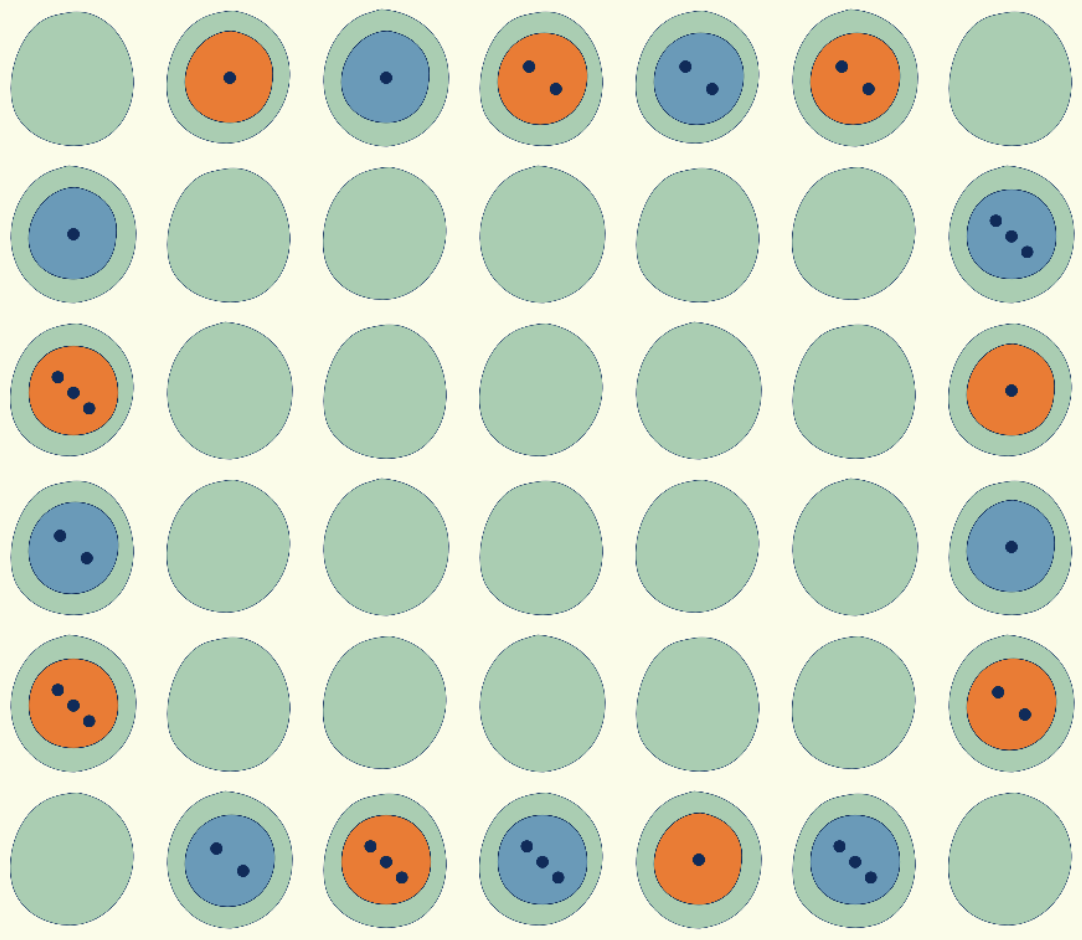
We have two free abstract games you can try online: Lily Hop and Pebble Huddle. Both belong around the second step of the progression ladder. They are not the very simplest or shortest games, but their entry threshold is still low.
Being able to try them online is a real advantage. You do not need any equipment, you can restart whenever you like, experiment again and again, and learn the rules easily. If the games work for you, printable versions and teaching materials can take them from the screen to the table.