
Board games about programming? Why would games like these even be made? What could the designers’ goals be? Why do we need them? Can an educational game actually be entertaining? And if it is entertaining, does it really teach anything at all? I think these are all fair and important questions.
Even my own daughter (9) looked at me with wide eyes when I told her what kind of game we were going to play. She simply could not understand what could possibly be fun about it — especially since she is definitely not a particularly digital-minded child. Spoiler: she really enjoyed it, and we ended up having some great conversations about the topic.
Since I am a game designer myself, I naturally consider myself a very author-oriented player. For me, it matters who designed a game, and I definitely have favorite designers of my own (such as Stefan Dorra, Reiner Knizia, Alex Randolph, or Wolfgang Warsch). But in the case of this review, I feel it is especially important to talk a little about the designer, because it is absolutely part of the context.
When we first started exchanging messages, it never even crossed my mind that I was not talking to someone roughly my own age — an experienced designer with years behind them. Then, as our collaboration began to take shape (the interview, the reviews), I started looking into her work more closely. I will simply copy her introduction here from the codermindz.com website:
""When she was 7 years old, Samaira invented STEM coding board game CoderBunnyz to teach coding to kids age 4-104. At 10, along with her brother Aadit, she invented CoderMindz, the first ever board game that teaches AI concepts. She has done over 500 workshops with her board game in Silicon Valley, teaching over 15000 kids, including over 50 at Google HQ. She also started an initiative “Girls U Code” to teach coding to underrepresented girls. She has received letters from “The White House” for her work and has been featured on TIME, Vogue, Today Show Show, CNBC, CNET, and over 100 other media platforms. She is has been the youngest speaker at places like MWC’19, C2 Montreal, and many other places. She wants every kid in the world to have the privilege to start on thier coding journey in order to have a better problem solving mindset. Her creations, CoderBunnyz and CoderMindz, are currently available on Amazon and Walmart.com""
About the Games in General
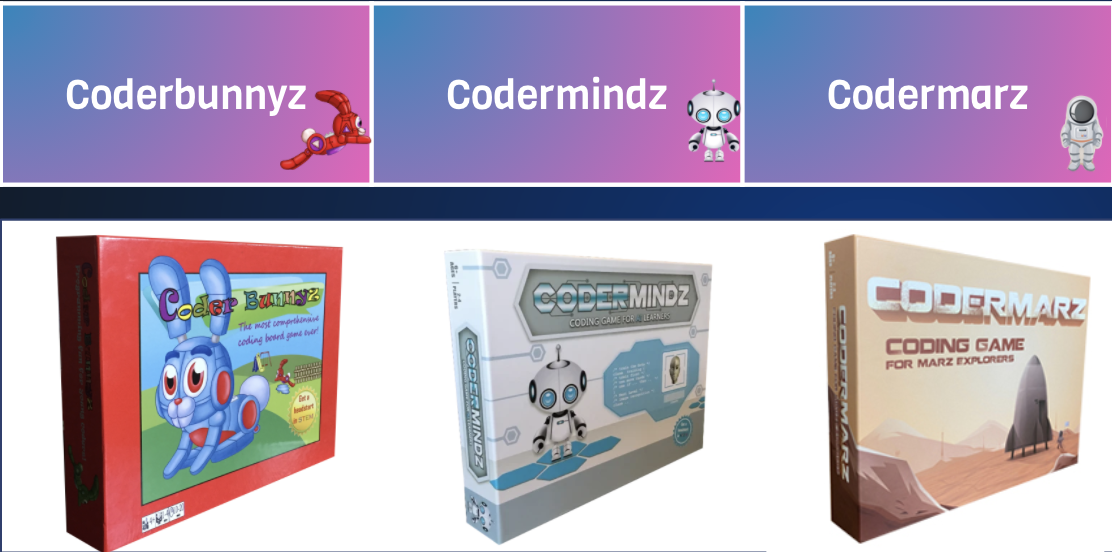
CoderBunnyz is aimed at the youngest children for whom it already makes sense to start exploring this topic. According to the recommendation, it can be played from the age of 4, and the playtime is also shorter to better suit that age group. Although it is officially playable solo, in my experience preschool-aged children are not typically board gaming alone, so a 2–4 player setup with at least one adult present feels much more realistic. (And of course, an adult would probably not play such a child-focused game alone anyway — except perhaps to learn it before introducing it to children.)
Its presentation is also clearly designed with children in mind: colorful, evoking a friendly and lovable digital world. At the same time, I personally found it somewhat less appealing visually than its two “older siblings.” Its gameplay is simple and intuitive, and from a professional perspective, I think it fits the developmental characteristics of its target age group very well. It is an excellent gateway into the world of coding.
CoderMindz and CoderMarz are clearly aimed at school-aged children, featuring a cleaner, more sophisticated visual style and more complex, longer gameplay experiences. One thing I would highlight about all of these games is how beautifully scalable they are.
The games can — and should — be introduced in a very simple way at first, allowing children to easily absorb the rules and become familiar with the basics of coding. Then, by gradually introducing more and more cards, both the gameplay experience and the learning process can become increasingly complex.
From this perspective, the newest member of the series offers the most, as its thematic layer is the strongest. While learning coding concepts, players can also learn interesting information about the planet itself. In addition, the game already offers a glimpse into the world of AI, as stated on the back of the rulebook: “AI Prediction – Deciding the outcome based on previous information and algorithms.”
Gameplay Experience
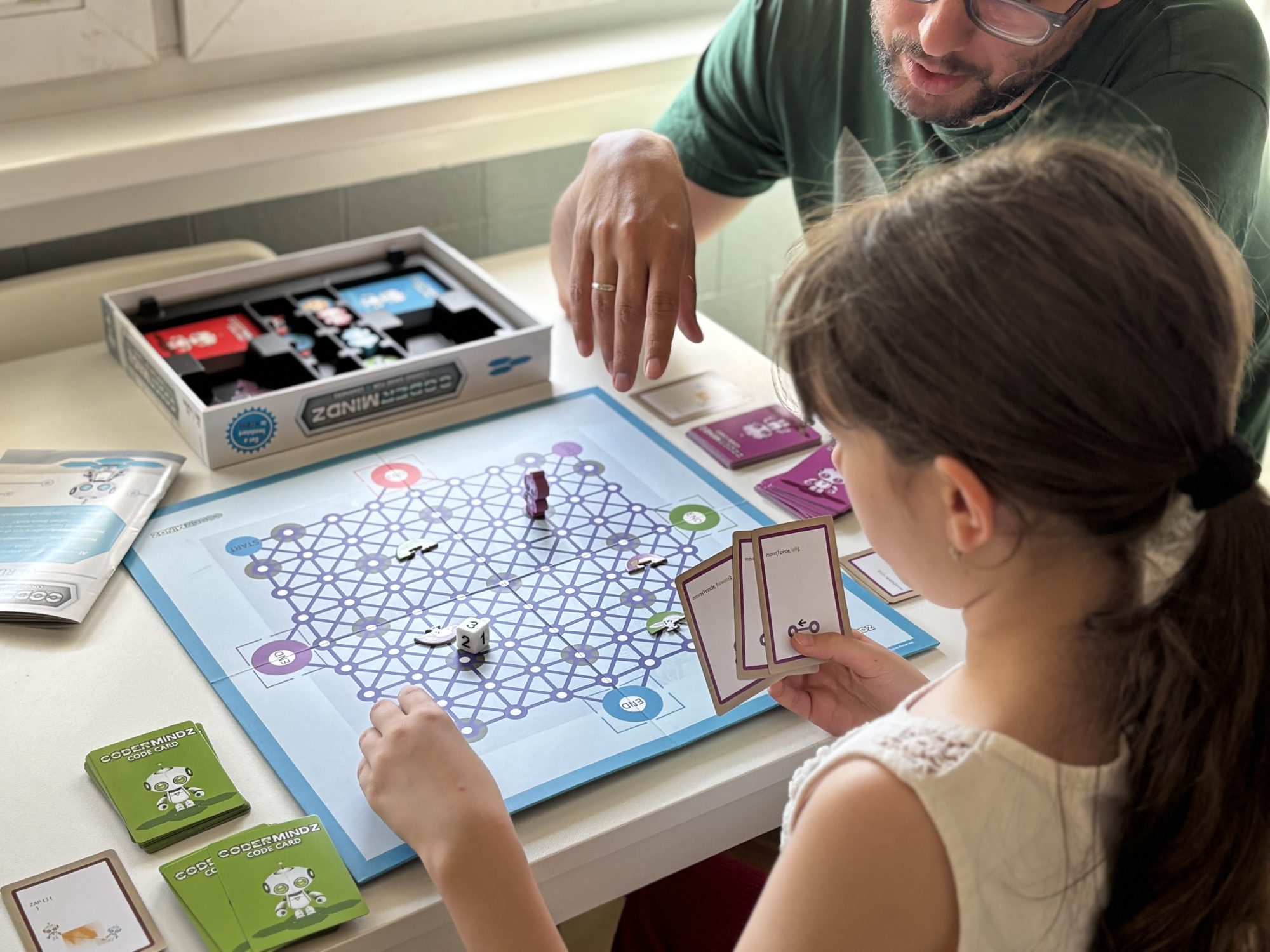
For us, CoderMindz turned out to be the best fit for my 9-year-old daughter, who is not particularly digitally minded by nature. As I already mentioned, she was not especially enthusiastic about the game at first. The topic itself did not interest her — in fact, she was even a little intimidated by it. At the same time, she plays a lot of board games and regularly playtests my unfinished designs, so she is generally quite open-minded. Still, if something feels unfamiliar or intimidating to her, it can definitely create a barrier at first.
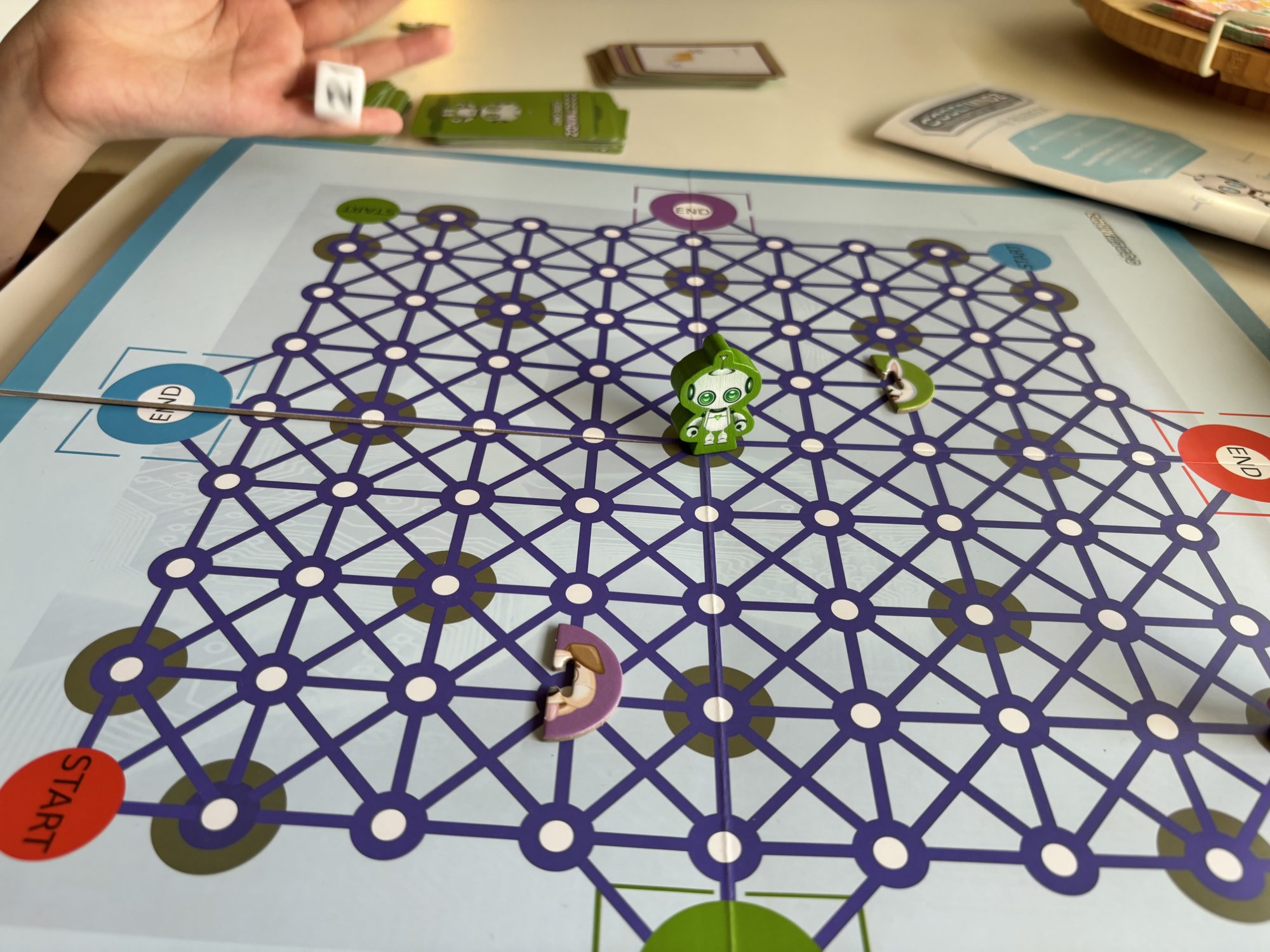
The game, however, broke through those barriers very quickly. She liked the charming little robots, quickly understood the board itself, and drawing cards or rolling dice are already completely natural activities for her. Since she tends to play cautiously, at first she only drew movement cards and carefully searched for safe spaces on the board.
I never do any kind of direct teaching while playing board games, so I simply waited patiently. During my own turns, I used some of the more advanced cards to spark her curiosity, and by the fourth or fifth round of the very first game, she had already started experimenting with them herself in a much more confident and curious way.
Besides smart decisions, luck also plays a major role in the game, so the chances remain very balanced throughout. I think this also helps a lot when the topic itself feels a little intimidating to someone.
The game genuinely sparked my daughter’s curiosity toward the subject. During the game she kept asking questions, and even afterward she would look through the remaining cards to see what they did. We also ended up talking a bit about actual coding itself — who she knows that works in the field, what kinds of products she uses that are built on it, and so on.
I do not think she is going to become a programmer — but that is not the purpose of the game anyway.
Algorithmic Thinking
For me, the broadest impact of these kinds of games lies in the development of algorithmic thinking. My first encounter with this type of mechanism in the world of board games was Ricochet Robots (Alex Randolph, 1999), followed later by Colt Express (Christophe Raimbault, 2014).
The former is an especially complex challenge and one of my favorite games, although I completely understand those who do not enjoy it, since it can be truly mind-bending. Meanwhile, Colt Express approached the coding of movement in a very playful way and created an exciting world right from the moment of its release.
The development of algorithmic thinking reaches far beyond the world of programming. In reality, it is about being able to break down a problem into smaller steps, recognize connections, think ahead, consider consequences, and make conscious decisions. These skills are just as important in everyday life as they are in mathematics, the natural sciences, or even human relationships.
Good board games are particularly effective at developing this way of thinking because players do not encounter it through abstract theoretical exercises, but through engaging and motivating experiences. Children often learn to plan, optimize, make mistakes, and redesign their strategies almost without noticing it — in other words, they practice exactly the kind of flexible thinking that is becoming increasingly important in the 21st century.
I also have a game of my own design that involves programming movement: Kiwi (2017). In that game, however, the main focus is not on the movement itself, but rather on tracking and mentally retaining movement, making memory — or more precisely working memory — the stronger element of the experience.
The CoderMindz game series is related to the games mentioned above, but its uniqueness lies in the fact that it approaches the topic explicitly from the direction of coding and very consciously aims to convey knowledge and experiences connected to it. From a board game pedagogy perspective, this becomes important when you want to make your developmental goals more explicit, because that awareness itself can motivate children.
If I want to completely “hide” the fact that we are actually learning about coding, then I would rather approach the topic through Colt Express. But if someone is consciously interested in coding and wants to learn about it in a playful way, then I would approach it through CoderMindz.
Overview
Creating educational games is not an easy genre to work in, but in this case I truly believe we are looking at an exceptionally successful project. The production quality and gameplay of these titles provide a genuinely enjoyable experience while also delivering tangible knowledge and learning opportunities.
What is more, the entire project is capable of functioning as part of a broader educational and training package. Of course, from this distance I could not personally experience that side of it, but as an educator, I believe that these kinds of complex, multi-layered projects can add extra depth to tools that are already highly functional and effective on their own.