
Overview
Although I really enjoy browsing for board games — especially print-and-play games, since they don’t naturally cross your path the same way traditionally published board games do — it’s a great pleasure that we’re now also receiving direct requests to review specific games. RollGovern: Egypt is one such case, and I had the chance to get to know it through its Scenario I map. You can also find this scenario on the designer’s Patreon page. As a small spoiler in advance: I absolutely recommend it — it’s a clever little brain teaser of a game.
The game is designed to be played solo, although several players can play alongside each other and compare scores. Playtime is around 20–25 minutes, and it’s recommended from age 10 and up. I think that recommendation is fair, although when it comes to children, we usually know them best — I can easily imagine more experienced 8–9-year-olds who could handle the game well.
Review
Print and play
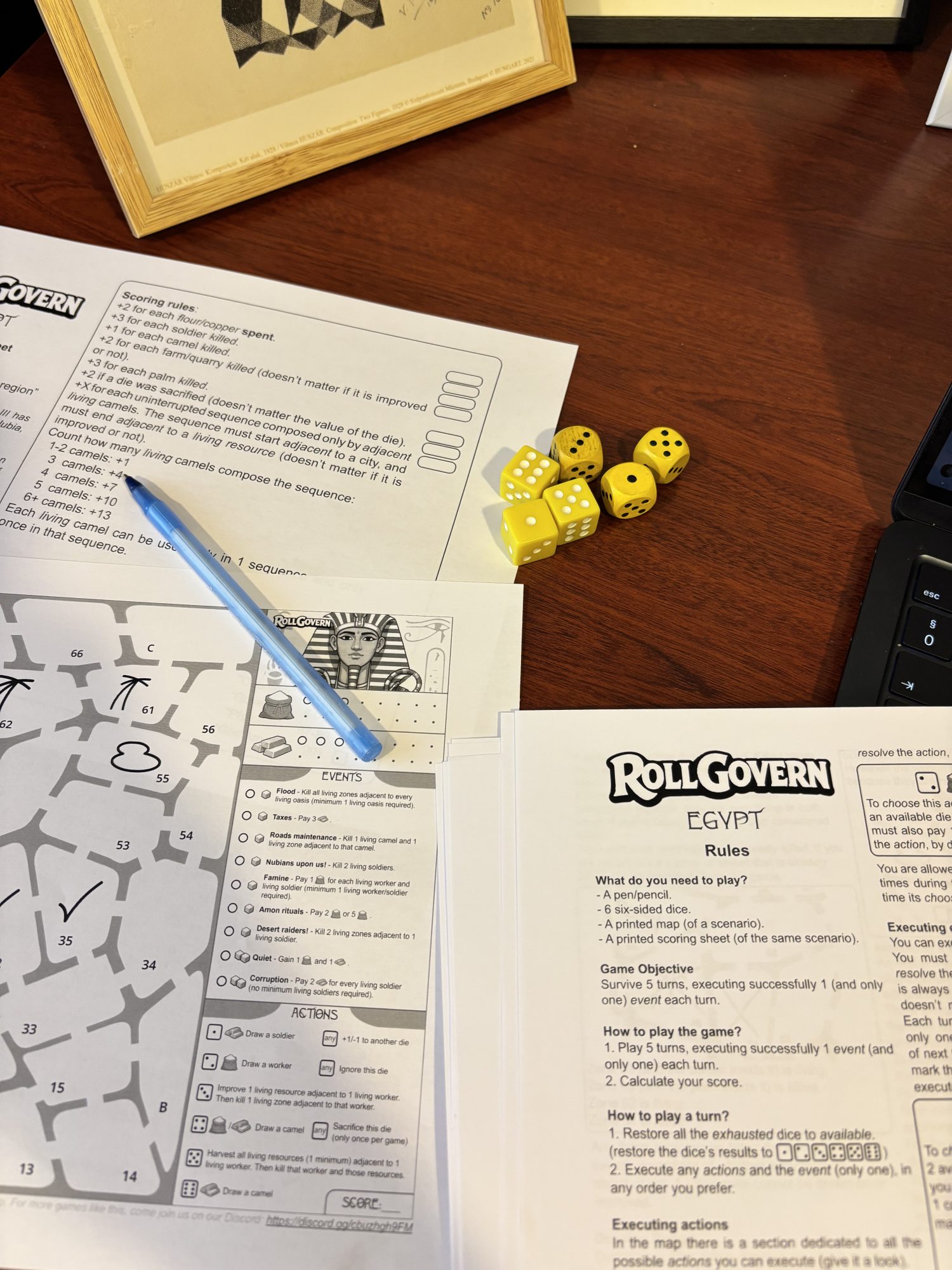
It’s a classic print-and-play game: the whole thing is just four pages — two pages of rules, one game board, and one scoring sheet — all available in two sizes, as well as in color and printer-friendly versions. I chose the latter, in A4 format.
The game is therefore very compact: there’s no cutting involved — you print it and you’re ready to play. Of course, you can laminate the board section if you want to, but that’s really a matter of preference and possibility. In addition, you’ll need six dice and a writing utensil.
Gameplay
There are six dice, a board, actions and events, things to draw — so it must be a classic roll-and-write game, right? Well, not really. For me, this is a much more complex, board-game-like puzzle. Everything depends on my decisions, yet I constantly have to align a lot of different factors. So far I haven’t performed particularly well, although I do improve from game to game as I explore the space of possibilities.
Since you execute actions, trigger events, move across a map, and everything is interconnected, the number of possible combinations is quite high and very hard to fully grasp. Because of this, learning the rules isn’t easy — but once you start playing, the game flows surprisingly quickly. The dice represent actions, but you also have resources, and you develop the map through their use.
Events can absolutely be used to your advantage, but sometimes it’s really hard to find the option that doesn’t completely derail your plans. In fact, simply making it through an entire game already feels like an achievement — which I find very exciting. I enjoy map-drawing games in general; they tend to have a pleasant flow. This one is perhaps a bit more puzzle-heavy than usual, but for me, that worked very well.
Illustrations
For me, with games of this type, the most important thing is having a clear, readable play space — and that works perfectly here. The game relies on a lot of icons and drawings, and these are handled very cleverly from a visual standpoint. The symbols work well, too; they’re genuinely the kind that even clumsy, two-left-handed people like me can draw without trouble.
I’m not particularly demanding when it comes to my own drawings — my Cartographers sheet looks terrible by the end of the game — but the possibility is very much there to end up with something coherent and visually pleasing. That’s actually something I really enjoy about games like this: through the game mechanics, we truly create a game visually. We’re not just placing pieces or moving markers around — we’re drawing it. And that adds a lot to the experience.
The PlayWise perspective
Regular readers will already know that the educator in me can never stay hidden for long, so I always look at games through that lens as well. This is very much the kind of game that can be brought out regularly for individual learning sessions, either at school or at home, and where a child’s progress can be tracked over time — since the scores are fully and objectively comparable.
To me, this game feels like a particularly complex logical challenge, precisely because it requires the coordination of many different factors, making it excellent for developing logical thinking skills. Its mathematical side is especially interesting too: the scoring system is layered and nuanced, and you often find yourself calculating which choices will yield how many points. From a pedagogical perspective, it’s always a win when you can motivate a learner to do a lot of mental arithmetic on their own — and here, that easily happens within a 20-minute session.
On top of that — and this is one of my personal fixations — there’s quite a bit of text on the game board. Until the actions and events are fully internalized, players constantly need to interpret short bits of written text, which is another excellent developmental opportunity.
So, dear parents and educators: if you’re looking for a logic game for a child who also happens to be motivated by the idea of ancient Egypt, don’t hesitate to give this one a try.
Overall Impression
In short: I liked it — and it frustrated me, because I can’t figure it out well enough quickly. But it’s the good kind of frustration. The kind that makes you sit down again and again, because you just can’t believe you’re unable to place a few camels and workers in the right spots, at the right rhythm.
The game really doesn’t seem difficult, yet the space and the range of options narrow very quickly. I find myself constantly thinking about how to maximize my score, so I’m sure I’ll keep tinkering with it and check out the other scenarios as well.
Have fun playing!
Mate's note:
As a player and as a designer, I'm increasingly drawn to the world of print-and-play games. It feels like this is the answer I've been looking for to my long-standing questions. I can buy new games without putting unnecessary strain on the environment. And I can create new games without putting unnecessary strain on the environment. Plus, this way my own games can reach people all around the world much more easily.
Check out PlayWise's games and the other reviews too!