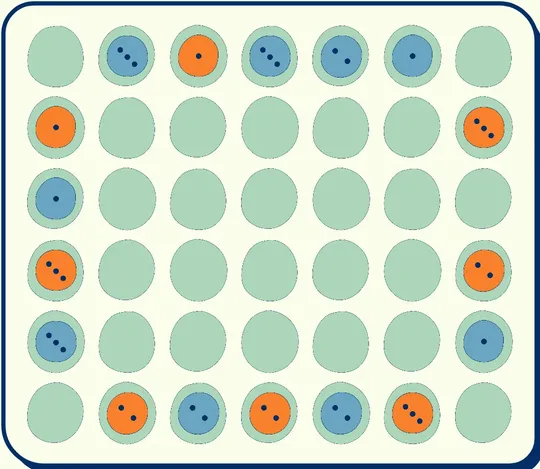
Chess is not the only abstract game — and it's far from the best entry point for kids. This article, part of our educational board games guide, shows where it's actually worth starting: games you can set up with a handful of pebbles in a minute (Nim, Lahti, Neutron), the great classics (Mancala, checkers, Go), and how you eventually arrive at modern gems like Santorini, Quarto, and Azul — plus an honest word about Hive and Onitama.
Non siamo abbastanza intelligenti?
Non so nemmeno cosa ho sentito di più dai genitori:
"Non sono abbastanza intelligente per gli scacchi..."
"Sarebbe bello se giocassero a scacchi, ma è troppo complicato per i miei figli..."
"In qualche modo, giochi come gli scacchi non sembrano abbastanza eccitanti per i miei figli; non succede mai niente di che."
Cominciamo col riconoscere che gli scacchi non sono l'unica opzione. Ci sono molti giochi semplici, adatti alla famiglia e facili da gestire. E ognuno di questi ha un fratello maggiore. Quindi, non c'è bisogno di buttarsi subito su quelli più complessi; possiamo sperimentare i nostri limiti e quelli dei nostri figli in forme più semplici, più brevi e quindi meno rischiose.
Il progresso non richiede che ci sforziamo; viene da sé. Man mano che lo sviluppo si dispiega, i giochi possono diventare più intricati e possiamo accompagnare i ragazzi il più a lungo possibile. E non abbiamo paura se ci superano in bravura; in realtà è quello che vogliamo, non è vero?
Niente tempo? Niente soldi?
Sì, anche questo è un problema. Comprare qualcosa di costoso e impegnativo solo per non avere tempo dopo? Idealmente, i bambini giocano molto sia a scuola che a casa, ed è fondamentale che i genitori prendano parte al gioco a casa.
Certo, è fantastico se un bambino frequenta un club di scacchi, ma il tempo libero di qualità trascorso a casa con i genitori, dove il gioco è un importante elemento organizzatore, non può essere sostituito. Fortunatamente, non solo i giochi lunghi e complicati sono intelligenti. Se abbiamo a portata di mano alcuni semplici strumenti, possiamo mettere rapidamente insieme giochi a casa facili da imparare e da giocare.
What is an abstract game, really?
Many people don't even realize how many abstract games they already know. If you've ever played Tic-Tac-Toe in a grid notebook at school, pushed pieces across a checkers board, or played a round of Nine Men's Morris, you've been in this world for years. And plenty of people would never suspect that Azul, a modern favorite in so many homes, is an abstract game too.
We call a game abstract when it has no theme. It typically asks for logical or strategic thinking, it's mostly played by two, it leaves luck out, and every piece of information is visible and available to both players. Game theorists call this last part "perfect information" — but you can simply think of it as a game with no secrets: no hidden cards, no dice, nothing up anyone's sleeve.
There are classic counterexamples, of course. In dominoes, we draw tiles; in backgammon, we roll dice. And among the modern abstracts, Azul happily uses luck and plays well with more than two people. The borders are soft — and that's perfectly fine.
Why are abstract games so good for development?
The baseline answer is well known: abstract games train concentration, planning, pattern recognition, and strategic thinking. All true. But our angle is a little different, and it comes from practice, not from lists — because the more interesting questions are why children fall for these "boring" games when they meet them the right way, and what exactly a theme-less game does that a themed one doesn't.
Perché i giochi astratti sono considerati noiosi?
No, non è perché mancano di colore. Piuttosto, è perché non li incontriamo al momento giusto e nel contesto giusto — né la prima volta, né la seconda volta, e nemmeno l'ennesima volta.
Ho insegnato il Kalah a più di 300 persone, le regole della Dama Internazionale ad almeno 200, e non riesco a ricordare un solo adulto o bambino che abbia opposto resistenza. Invece, sento spesso che non solo hanno imparato il gioco, ma l'hanno anche comprato e continuano a giocarci. Entrambi i giochi sono regolarmente presenti anche nelle mie sessioni educative.
Immagina la gioia di partecipare alla festa di diploma di una famiglia svantaggiata e vedere uno dei tuoi studenti tirare fuori un Kalah per fare qualche partita. Ottenere questo non è magia; sono i giochi stessi a fare il lavoro. È una questione di costruzione consapevole: cosa, quando e in quale ordine?
Games that ask to be solved
My own path in board game pedagogy says a lot here. I arrived from the direction of modern board games, because I felt education was focusing almost exclusively on the "smart" games — chess above all, maybe checkers and Nine Men's Morris — while there's an enormous amount of developmental potential even in silly party games. For years I worked on hiding the learning inside play, mostly with disadvantaged children who were hard to motivate.
Then something interesting happened: it turned out that many of these kids are drawn precisely to simple, clean structures — Kalah, International Checkers, Nim, Lahti, Neutron. An abstract game asks you, quite openly, to crack it. A good modern board game invites you to play with it; a classic abstract game also wants to be figured out. It stands in front of you bare — just the position, the decision, and the consequence. There's no story to hide in: the brain has to work with the pure structure.
It's a fascinating experience to understand perfectly how Go works and still not be able to make it work, because putting every building block in the right place is desperately hard. So "hide the learning" is not a universal truth after all. Sometimes what moves a child forward is the opposite: putting the difficulty right in front of them — this is hard, and it wants to be solved. Think of puzzle locks: they annoy everyone to death, yet everyone keeps picking them up. Or the most famous Hungarian invention, the Rubik's Cube, which everyone owns and far fewer can solve. A more conscious learning situation can be the more effective one — as long as it doesn't paralyze the learner. That's the balance we're always weighing.
If you're curious about the broader picture — what board games do to a developing mind — we've collected the research and our classroom experience in a separate piece on the developmental impact of board games.
Perché abbiamo tempo per lo sviluppo?
A volte, l'impazienza sorge anche tra educatori e genitori. Vogliamo tutto e subito perché un altro bambino potrebbe già saperlo, il nostro bambino potrebbe saperlo pure lui o, secondo il programma di studio, non dovremmo più essere a questo punto.
Nel frattempo, i bambini percorrono la loro strada e noi possiamo aiutarli gentilmente e con modestia, ma non c'è bisogno di stressarsi se non ci sono problemi significativi. E non è certamente un grosso problema se qualcuno all'età di 5-6 anni non è in competizione con giocatori di scacchi con un punteggio Elo superiore a 2000.
L'apprendimento è un viaggio, parte del quale include la ricerca di ritmo o motivazione, e vari giochi possono aiutare in modo superbo in questo. Giocare a molti giochi è più facile quando sono rapidi da imparare e brevi. Un genitore o un educatore può capire da un gioco di due minuti se ai bambini è piaciuto, se vale la pena approfondirlo e se abbiamo trovato l'inizio di un percorso.
The progression ladder: which game at what age?
What I recommend first depends on a great many things. But if I can choose, Nim, Lahti, and Neutron are what I show first: pebbles, perhaps a tiny board — and you still have to think. They show beautifully what the world of abstract games is about, yet they can be learned and cracked quickly.
As for ages: labels on boxes usually say 6+ or 8+, but with abstract games the rulebook is rarely the obstacle. Their rules are often simpler than those of the board games recommended for young kids — what's challenging is not understanding the rules but operating what grows out of them. So when starting out, I only really watch one thing: length. Choose short games first. Mancala isn't even that short, and I've still taught it to preschoolers countless times — but Nim or Neutron are the safer first calls.
| Stage | Age guide | Games | Why these |
|---|---|---|---|
| First moves | 4–6 | Tic-Tac-Toe, Nim, Lahti (miniature checkers), Neutron | A handful of pebbles, a tiny board, rules in a minute — and 6–8 rounds fit into 15 minutes. |
| Building confidence | 6–9 | Kalah (Mancala), Gomoku, Quarto, Quoridor, Blokus, Santorini (base game) | Familiar ideas with one new twist at a time; short games with real decisions. |
| Going deep | 9+ | International Checkers, Go (9×9), Onitama, Hive, Azul, Twixt, YINSH (GIPF project) | Depth that rewards practice — these can stay with you for decades. |
Take the ages loosely. And don't be afraid of the "smart" games: notice how few rules checkers or Nine Men's Morris actually has. Even chess doesn't have many rules — it just has many kinds of pieces and a long playing time.
The next four chapters walk this ladder game by game: line-winning games, checkers, the pebble-counting family — and the variations that keep all of them fresh.
Tris e Giochi di Allineamento
Molti giochi sono sottovalutati in tutto il mondo e il Tris è certamente uno di questi. Con una valutazione media di 2,7 nell'elenco di BoardGameGeek, non rientra nei primi 25.000 giochi. Sebbene Gomoku abbia solo un punteggio di 5,9, la sua difficoltà è 1,85 rispetto all'1,28 del Tris, e il tempo di gioco è passato da 1 minuto a 5 minuti. E questo è ciò che stiamo cercando.
Il Tris è un gioco meraviglioso per i bambini in età prescolare perché il campo di gioco è limitato e il numero di pezzi è finito, rendendolo facile da cogliere. L'obiettivo è avere tre dei nostri pezzi uno accanto all'altro in diagonale, in verticale o in orizzontale. I due giocatori si alternano e qualcuno vince rapidamente – se capiamo il gioco, quel qualcuno sarà il giocatore iniziale.
Il tabellone di Gomoku è più grande e più pezzi devono essere posizionati uno accanto all'altro. Inoltre, possiamo lasciarci andare, giocando su una griglia quadrata, disegnando cerchi e croci con una matita. Ho molti ricordi emozionanti di quando giocavo sotto il banco a scuola.
E puoi spingere le cose ancora oltre. I Tőtikék (questo è un termine ungherese, che indica che le righe devono essere riempite) sono giochi in cui i sassi/pezzi posizionati scivolano verso la freccia finché non colpiscono un ostacolo (il bordo del tabellone o un altro sasso/pezzo). Quindi, spesso, puoi posizionarli dove vuoi solo dopo lunghe costruzioni, ma nel frattempo, la situazione cambia costantemente.
Quindi, con i nostri bambini, possiamo sederci a giocare a Tris anche all'asilo, e possiamo anche creare un set carino e personalizzato. Da qui, sarà molto facile passare a giochi di allineamento più complessi, seguendo comodamente il percorso di sviluppo.
And if your child is most easily won over by a modern, colorful box, Quarto is my choice from this family: a line-winning game with a twist, a close relative of Tic-Tac-Toe, so it feels instantly familiar. The twist that makes it special: the piece you place is chosen by your opponent.
2x5 o 10x10
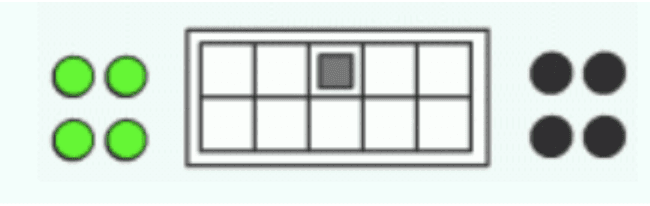
Molti forse non lo sanno, ma esagerando un po', si può giocare a dama su un tabellone di qualsiasi dimensione. Lahti è la forma più semplice che conosca. Ci sono 2 file con 5 campi ciascuna e uno dei due campi centrali è contrassegnato, ad esempio, con una corona. A turno, posizioniamo i nostri 4 pezzi ciascuno e la battaglia può iniziare. Il vincitore è colui che elimina tutti i pezzi dell'avversario o colui a cui è rimasto solo 1 pezzo ma che può entrare nel campo contrassegnato dalla corona.
Le mosse possono essere fatte lateralmente e diagonalmente, la presa è obbligatoria se possibile, il che possiamo eseguire saltando il pezzo dell'avversario se c'è uno spazio vuoto dietro di esso. Il gioco procede rapidamente; si possono giocare 8-10 turni in meno di 20 minuti mentre si imparano le basi della dama.
La maggior parte delle persone gioca a dama su un tabellone 8x8, ma la Dama Internazionale su un tabellone 10x10 e le sue regole esprimono appieno il potenziale della dama. Con 20 pezzi ciascuno, l'obiettivo è annientare l'avversario. Possiamo solo muoverci in avanti, in diagonale, sui quadrati scuri, e solo uno alla volta. Se possiamo saltare l'avversario, dobbiamo farlo, e così facendo, prendiamo il pezzo.
Se ci sono più prese sul tabellone, dobbiamo sempre scegliere quella più lunga perché ci sono prese combinate, come si vede spesso nei film. Inoltre, anche la presa all'indietro è possibile ed obbligatoria. Se raggiungi la linea di fondo dell'avversario, il tuo pezzo diventa un re (figura a doppia altezza), che può poi muoversi di un numero qualsiasi di spazi e prendere da qualsiasi distanza.
La Dama è fondamentalmente un gioco eccitante e aggressivo che incanala e rilascia l'aggressività all'interno dei suoi confini. Le regole sono semplici, ma su tabelloni più grandi c'è molta profondità. Puoi anche avventurarti nella competizione, ma, come sappiamo, non è l'obiettivo principale.
Un Incontro Amichevole con gli Insiemi
Quando guardiamo un mucchio di qualcosa, è bene avere un'idea approssimativa di quanto sia perché da esso si possono trarre molte conclusioni. Per esempio, se una manciata di spiccioli è sufficiente per un biscotto da accompagnare alla bibita. In molti giochi da tavolo, stimiamo le quantità e un gioco di base per questo è Nim, che ha numerose varianti.
In genere, l'obiettivo è raccogliere l'ultimo sassolino, i quali, secondo alcune regole, sono raggruppati in insiemi durante il gioco, e di solito, nel proprio turno si può pescare solo da un insieme. Per un po' ci limitiamo a raccogliere sassolini, poi iniziamo a contare, e poi ci lasciamo alle spalle anche quello perché, a colpo d'occhio, sappiamo se l'insieme ha un numero di elementi pari o dispari, e questo ci basta.
Dopo molti round di Nim, il Mancala non ci sembrerà sconosciuto. Anche qui lavoriamo con le quantità, poiché, a parte i nostri contenitori, prendendone uno per uno in senso antiorario, spargiamo i nostri sassolini. L'obiettivo è avere più sassolini nel nostro raccoglitore entro la fine della partita rispetto all'avversario. Riconoscere le quantità è importante perché, con mosse strategiche, possiamo rubare o fare mosse multiple, accumulando così più sassolini.
Se vuoi vedere esattamente come funziona, la nostra guida illustrata a Mancala e Kalah (in inglese) spiega la preparazione, la semina, i turni extra, le catture e la fine della partita.
Kalah, by the way, is the most popular game both in our home and in my teaching practice — wonderfully simple rules, an unusual, attractive look, and genuine tactical depth. It's no accident that my own game, Lily Hop, is a Kalah-type game: you can play it for free right here on the site, and it even comes with ready-made learning material.
È evidente che non siamo più al livello del Nim, ma forse è anche chiaro che il percorso potrebbe essere più facile partendo da lì rispetto a iniziare direttamente da qui, perché il Mancala può consistere in 20 minuti di lanci senza scopo se non ci siamo preparati.
Il riconoscimento delle quantità e degli schemi gioca un ruolo significativo anche nel gioco più profondo del mondo, il Go. Sull'enorme tabellone del Go, vedere la forza degli schemi e comprenderne le possibilità è essenziale per un gioco di successo. E così, progrediamo da una manciata di sassolini ordinatamente disposti al Go, che continua a conquistare da oltre 4000 anni.

Teniamo d'Occhio le Varianti!
Non entrerò in ulteriori dettagli, ma vorrei attirare l'attenzione sulle varianti di due giochi più popolari.
Il Mulino è anche un gioco noto e molto giocato in passato che può diventare noioso dopo un po'. Ma sapevi che esistono vari tabelloni del Mulino? L'esperienza è la stessa su ciascuno di essi? La risposta è decisamente no. Simile ma non identica, e questo è fondamentale, soprattutto se abbiamo figli riluttanti a uscire dalla loro zona di comfort, ma vogliamo comunque che scoprano cose nuove.
All'inizio del testo si è discusso ampiamente degli scacchi, probabilmente il gioco più conosciuto al mondo e giustamente popolare, eppure comprensibilmente temuto. Nella mia esperienza, per i bambini non particolarmente interessati agli scacchi, gli eventi tendono a svolgersi troppo lentamente. Ci sono molte varianti emozionanti anche per gli scacchi.
Nel nostro libro 'Jól játszani' (Giocare Bene) scritto in co-autoraggio con József Jesztl, abbiamo introdotto gli Scacchi Kobold che, su una scacchiera più piccola e incorporando elementi dello Shogi, offrono un'alternativa più dinamica e veloce per coloro che sono interessati agli scacchi ma non abbastanza devoti al tradizionale ritmo lento.
The modern classics: bridges, not chess substitutes
Let me start with a confession: I don't think hunting for a "chess alternative" is the right direction. Whenever I read that a game is "just like chess, but…", I get suspicious — if we want chess, let's play chess. Chess itself is pure; it's just hard to learn and hard to play well, and I understand why people fear it. But if someone is drawn to abstract games, I wouldn't necessarily go looking for alternatives in the modern world — I'd start with the pure, short classics above.
Take Hive, so often recommended as the chess substitute. Between Hive and chess, honestly, I see very little connection. Both are for two players? Yes. There are moves? Yes. Anything else? Not much. Hive is a big personal favorite of mine, but I don't consider it easy to teach to children: "no board" sounds like freedom, yet in practice, it's often too much freedom, and Hive is a genuinely complex game with many piece types, movement rules, and an unusual environment. Onitama looks more chess-like with its board and pawns, but its rotating movement cards open completely different dimensions again. In an abstract game, I look for purity — that's what I teach first.
Where Hive, Onitama — and Azul — do come to my mind is later: when the abstract games are already going well and I want to open the door toward modern board games, because each of them carries something from that world. They are bridges, not starting points.
Santorini: the one that wins young kids over
Santorini is spectacular, smart, and easy to learn. The base game works well before school age — it's purely a matter of practice. I personally skip the god powers even with older players, because for me they wash away exactly the clean elegance I love. (That's taste, not law.) In my sessions with kids, Hive and Onitama never became favorites — but Santorini won several children over. I'm convinced the building is what does it: they get to tinker and create, and for that, they'll happily hunt for the logical moves.
Azul: the bridge between two worlds
People argue endlessly about whether Azul is a "real" abstract game — it has a theme, but the machinery underneath is pure abstract. Whenever you see a debate like that, one thing is certain: the game is a superb bridge between the two worlds. I've taught Azul to someone who knew abstract games well but wasn't open to modern board games at all — and to someone who had declared all abstract games boring. It was a convincing answer to both problems.
Twixt, Gigamic, and the GIPF project
And don't let anyone tell you abstract games are all centuries old — modern designers have produced exciting titles too. One of my favorites is Alex Randolph's Twixt, and Gigamic's now-classic releases are important to me as well: Pylos, Quarto, Quoridor. Blokus, with its Tetris-like territory claiming for up to four players, belongs on the family shelf too. And if you're after the true brain-burners, the GIPF project (YINSH, TZAAR, DVONN and company) is made for you. It doesn't pretend to be anything other than what it is: beautiful, clean, complex abstract games.
You'll find more family staples like these in our essential board games guide.
One set, many games: an abstract shelf for pennies
Simple board games are all easy to make at home. My standing advice: collect decorative pebbles in at least three colors, and they'll serve you in a surprising number of games. Boards can simply be drawn — or, if you want something nicer, design and print them, then laminate.
My favorite "one set, many games" combinations:
- A Go board and stones → Go, Gomoku, Pente
- An egg carton and small stones → Mancala
- A squared notebook and a pencil → Tic-Tac-Toe, Gomoku — anywhere, anytime
- A handful of pebbles in two colors and a drawn grid → Nim, Lahti, Neutron
You can build our games at home too: we've made downloadable, nicely designed boards for Lily Hop and Pebble Huddle. And I love playing on the ground — anything works on a board chalked onto asphalt, and Kalah is wonderful in pits dug into wet sand. Be creative!
And before you buy anything: play online. Trying abstract games on free platforms like BoardGameArena or boardspace.net is the most cost-effective way to find out whether this type of game is for you. Right here on PlayWise, you can play Lily Hop and Pebble Huddle free in your browser.
If this budget-friendly angle speaks to you, our whole guide to games you can play without anything continues the thought.
How to introduce abstract games — and what about losing?
A few practical principles that have served us well, whether you're a parent or a teacher:
- Don't over-explain the first game. If the rules need more than a minute or two, pick a shorter game.
- Play right away instead of presenting. The game teaches itself faster than we can describe it.
- Play real games — don't engineer the outcome. Both losing and winning are experiences that need practice.
- It's best when the adult is learning too: equal chances make the strongest sessions.
Should we teach kids how to lose?
I think the focus is off when we ask how to teach a child to lose. The real goal is to build a culture of play in which who wins and who loses is simply not the main point. We play for the experience — to learn, to get better, to grow. We fixate on the losing question because angry, melting-down kids disturb us, and then nobody can concentrate on what actually matters.
And something we rarely say out loud: children can't win either. It's not just that they sometimes gloat — much more importantly, they often can't genuinely experience that they were clever, that their good decisions added up to something.
If we're lucky enough to build from zero, I suggest starting with short games that beg to be replayed — Nim, Lahti, Neutron. Kids understand them fast, master them fast, and six or eight rounds fit into a quarter of an hour, which is the best learning there is. The other track is bringing in games with luck — dice games like Pig or Katego: minimal components, simple rules, short rounds. From there, I open toward modern games through luck, or through party games. What I've just described is weeks' worth of ammunition — and for those weeks, losing won't be a topic at all, while the joy of play quietly soaks in. After that, going deeper is much easier.
One more tool worth knowing here: playing with a handicap. We've written a whole piece on giving advantages — how a well-chosen head start keeps games honest between unequal players.
Frequently Asked Questions
Coraggio, Serenità
Non abbandoniamo il mondo dei giochi astratti solo perché possono sembrare un po' impegnativi. Invece, cerchiamo punti di partenza più semplici e costruiamo in modo meticoloso; ne vale la pena. Non è certamente una coincidenza che questi giochi siano con noi da centinaia, a volte anche migliaia di anni, mentre nel regno dei giochi da tavolo moderni, titoli vecchi di soli 10-20 anni sembrano spesso già usurati.
Sveliamo insieme il loro segreto, e il primo e più cruciale passo, che giustifica la loro esistenza, è giocarci!
Continua a esplorare i giochi di strategia astratti
Cerchi il gioco giusto?
Scopri
12 giochi di strategia brevi per due giocatori, con vera profondità: da Nim e Lahti a Santorini, Hive, Kalah e Go.
Vuoi imparare il Kalah?
La nostra
guida illustrata a Mancala e Kalah spiega preparazione, regole, catture, turni extra e strategia di base (in inglese).
Giochi con i bambini?
Leggi
come insegnare i giochi di strategia ai bambini senza togliere loro la gioia della scoperta.
Letture Correlate
Niente spam, mai. Cancellati in qualsiasi momento.
Diffondi il Divertimento dell'Apprendimento!
Ti piacciono i nostri contenuti? Mostra il tuo supporto condividendo la nostra pagina con i tuoi amici e aiutaci a ispirare più famiglie ed educatori con la gioia di imparare attraverso il gioco! Le tue condivisioni fanno davvero la differenza. Grazie per essere una parte meravigliosa della nostra comunità!