
Why short games?
It bothers me too that we seem to search for the quick and the short in everything, as if there were no time for anything. But here I mean something slightly different. A short playing time usually comes with a simple structure: a quick rules explanation, quick understanding, and many, many games — which means a great deal of practice can fit into half an hour.
So this is not only about having little time. It is about a low entry threshold. We may be beginners in board gaming altogether, or perhaps only unfamiliar with abstract games. Either way, there is no reason to overload someone or frighten them away with a difficult, complex game. If we know where to begin, we can lead people gently into the exciting world of abstract strategy games.
The games at a glance
| Game | Age guide | Time | Rules learning | Beginner-friendly | Free to try |
|---|---|---|---|---|---|
| Nim | 4+ | 2–5 min | 1 min | Very high | Yes — use any small objects |
| Tic-Tac-Toe | 4+ | 1–3 min | 1 min | Very high | Yes — pencil and paper |
| Lahti | 5+ | 3–5 min | 2 min | Very high | Yes — draw the board |
| Pebble Huddle | 6+ | 10–15 min | 3 min | High | Yes — online |
| Quarto | 8+ | 10–15 min | 3 min | High | No official free version |
| Quoridor | 8+ | 10–15 min | 3 min | High | No official free version |
| Santorini | 6+ | 10–20 min | 3 min | High without god powers | No official free version |
| Hive | 8+ | 15–20 min | 5 min | Medium | No official free version |
| Kalah | 5+ | 10–20 min | 5 min | High | Yes — easy to make |
| Lily Hop | 6+ | 15–20 min | 4 min | High | Yes — online |
| Twixt | 8+ | 15–20 min | 4 min | Medium | Yes — graph paper |
| Go on 9×9 | 6+ | 15–20 min | 5 min | Medium | Yes — online or drawn |
Take the ages and times as guides, not promises. Children differ enormously, and the same is true of adults. I care much more about what someone already enjoys playing than the number printed on a box.
Games that take about five minutes
Nim
If you have children, you probably have a collection of pebbles at home that can finally be put to use. If not, buttons, matchsticks, tokens, or anything else that can be arranged into piles will work. Nim has many forms; this one begins with fifteen objects in piles of 5, 4, 3, 2, and 1. You can find the traditional game on BoardGameGeek.
Two people take turns. On a turn, choose one pile and remove as many objects as you like from that pile. The winner is the player who takes the final object. If you choose the pile of four, you may remove one, two, three, or all four — but nothing from another pile during the same turn.

If you have sixteen objects instead, arrange them as a four-by-four square. In this version, you may remove any number of adjacent objects from one row or column, but you cannot jump across a gap. It is still quick, but it asks a different question.
And if you only want to have fun, play with snacks: whatever you take, you must eat or drink. Suddenly removing all five objects may be strategically unwise — unless those five objects happen to be excellent chocolates.

Tic-Tac-Toe and line-winning games
Many games are underestimated, and Tic-Tac-Toe is certainly one of them. It is a wonderful preschool game because the playing field is limited and the number of pieces is finite. The aim is to place three of your marks in a row — horizontally, vertically, or diagonally. The two players alternate, and the game is over almost immediately.
Gomoku expands that familiar idea: the board is larger, and five pieces must form a line. You can play on squared paper with circles and crosses; I have many fond memories of games played under the desk at school.
You can twist the structure further with games in which pieces slide in the direction of an arrow until they meet the edge or another piece. The place where you choose to insert a piece and the place where it finally stops may be very different, and the position keeps changing while you build your line.
That creates a comfortable path. Start with Tic-Tac-Toe in preschool, perhaps with a cute homemade set. Move on to Gomoku, then to more complex line-winning games. If a modern, colourful box helps, Quarto is my choice: it feels familiar, but your opponent chooses the piece you must place.
A checkers variation: Lahti
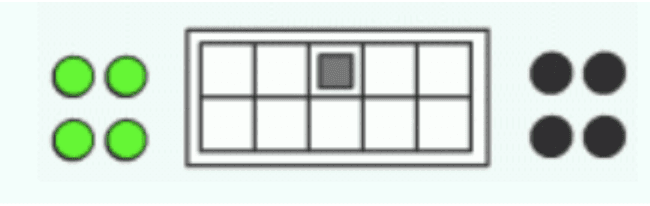
With only slight exaggeration, you can play checkers on almost any size board. Lahti is the simplest form I know. It uses two rows of five spaces, with one of the two middle spaces marked — perhaps with a crown. The players take turns placing their four pieces, then the battle begins. You win by capturing all opposing pieces, or by reaching the marked space when you have only one piece left.
Pieces move sideways and diagonally. Capturing is compulsory whenever possible: jump over an opposing piece into the empty space behind it. A game is so quick that you can play eight or ten rounds in twenty minutes while learning the foundations of checkers.
Most people know checkers on an 8×8 board, but International Checkers on a 10×10 board brings out the family’s full potential. Twenty pieces per player, compulsory captures, backwards captures, multi-jump combinations, and kings that travel across the board create a deep and aggressive game. Lahti itself does not currently have a BoardGameGeek entry, which is one reason this miniature version deserves a proper introduction here.
Games that take about 10–15 minutes
Pebble Huddle
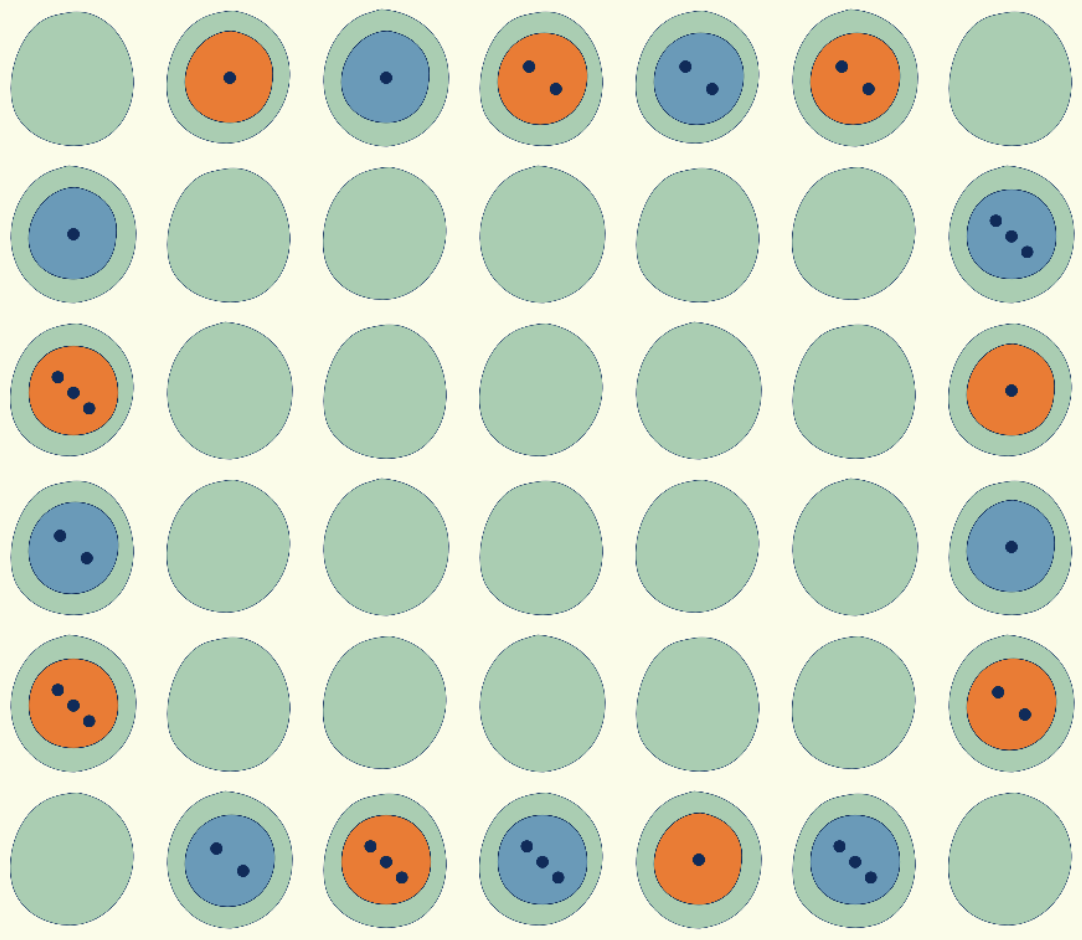
Pebble Huddle is a very simple game in which your pieces move different distances. Your goal is to gather them into one connected group before your opponent does. Capturing is possible, but it is not always helpful: every captured opposing piece is one fewer piece your opponent must bring into the huddle.
You can read the rules and try Pebble Huddle online for free. It is our own game and does not yet have a BoardGameGeek entry.
Quarto
I first encountered Quarto at a summer camp, playing with a set one of my teachers had made from oven-bake clay. Years later, I met the published edition at a board game event. Seeing it again was a wonderful aha moment.
I already love line-winning games, but Quarto’s twists make it stand out. You do not choose a piece for yourself; your opponent hands you the piece you must place. And a winning row can be formed through any of four shared attributes: colour, height, shape, or whether the piece is solid or hollow. It is not effortless, but it is short, clever, and quick to learn.
Quoridor
Although Quoridor can be played by four, I still think of it primarily as a two-player game. The walls you place to slow down your opponent also restrict the spaces through which you can travel. There is a serious twist in that logic: sometimes it is worth limiting yourself a little if that limits your opponent much more.
The rhythm is fascinating too. For a while both players feel their way forward, place walls, and advance slowly. Then the endgame suddenly unfolds, and it becomes clear who counted more accurately and still has time to reach the opposite baseline.
Santorini
Santorini looks spectacular on the table, yet its basic game is remarkably easy to enter. On every turn, move one of your builders to a neighbouring space, then build beside the piece you moved. Reach the third level of a building and you win. A dome closes a tower, so every construction changes both the routes upwards and the spaces still available.
I would begin without the god powers. The plain structure is already a strong, elegant two-player abstract game: movement, height, blocking, and timing are visible on the board. Once that feels familiar, the gods add asymmetric abilities and a new puzzle each time. This makes Santorini a particularly good bridge between an inviting modern production and the deeper logic of abstract games.
Games that take about 15–20 minutes
Hive
Hive does not need a board. The hexagonal insect pieces create the playing area as the game develops, and your aim is to surround the opposing queen bee. Each insect moves differently, but one rule holds the structure together: the hive must remain connected.
That last rule is what gives the game its special tension. A piece may look free to move, yet lifting it would split the hive, so it must stay where it is. The chunky pieces, small playing area, and absence of setup make Hive an excellent travel game. It is a little less beginner-friendly than the games above, because the movement patterns need to settle, but once they do, the position becomes rich very quickly.
Kalah
We have a complete guide to this game, so I warmly recommend our article: How to Play Mancala (Kalah): Rules, Setup & Strategy.
You can also find Kalah on BoardGameGeek.
Lily Hop
Lily Hop is a Mancala variation. The sowing movement feels familiar, but capturing works differently, and here the players have stones of their own. If you like Kalah, it is worth seeing what this changes — and what it adds.
You can learn the exact rules and play Lily Hop online for free. It is our own game and does not yet have a BoardGameGeek entry.
Twixt
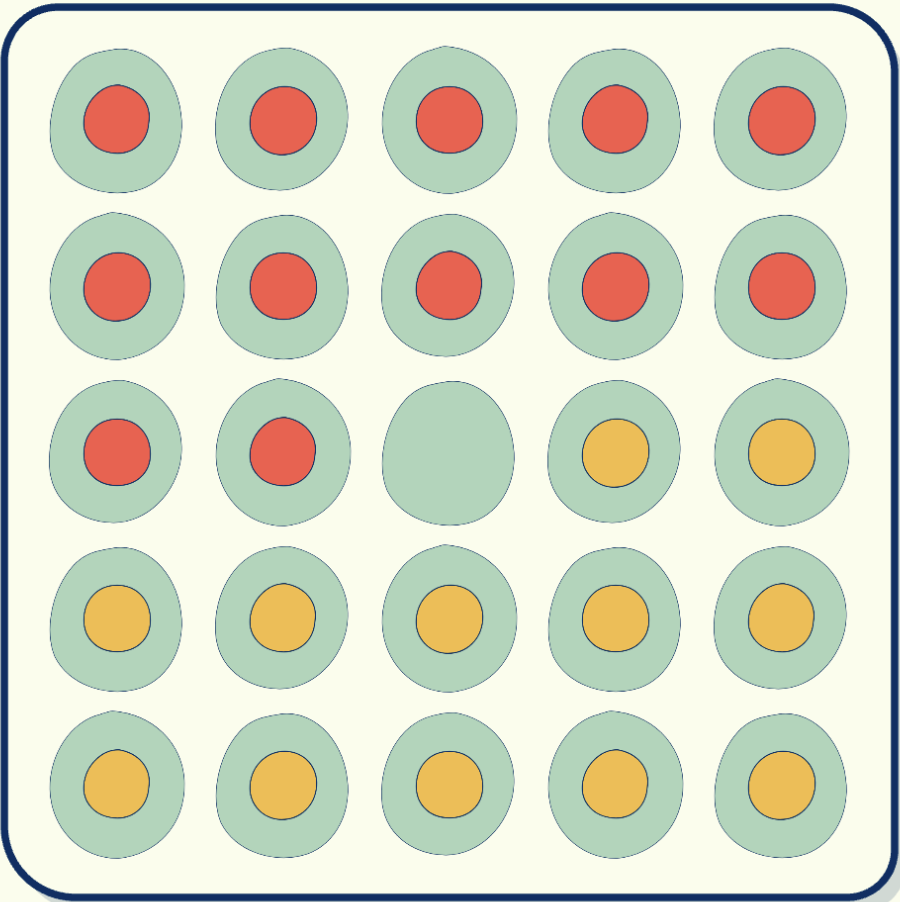
Twixt is an Alex Randolph classic. It can be difficult to find a copy, but you can also play it on squared paper. The aim sounds simple: connect one side of the board to the opposite side.
The players’ routes may not cross, so you can guide and obstruct one another. You must do that carefully, because blocking your opponent should also build your own possibilities. It sounds straightforward, but in practice it is a thoroughly brain-burning game.
If you are playing with a child
I find it difficult to recommend by age, because children differ so much. I would rather ask what they usually play and what their favourites are. That tells me far more about what may work.
If every game they name is a ten-minute party game, stay with Nim, Lahti, and Neutron and begin at the beginning. But if they love Azul, I can offer almost anything. After a short introduction, they will probably be able to choose for themselves.
This is also where I want to emphasise the importance of giving advantages and balancing chances. Do not simply let a child win; they learn nothing from that. If losing bothers them, give them an advantage. If it does not, just play and enjoy the game.
If you are looking for an adult opponent
I am going to make a bold recommendation: get to know Go. Smaller boards exist — 9×9 and 13×13 — and the rules are simple and natural. Do not worry about the game’s famous depth. That will reveal itself if you invest enough time.
People say a preschooler can understand Go, yet a lifetime is not enough to explore it fully. The rules feel so elegant and inevitable that if intelligent life has evolved anywhere else in the universe, they must be playing Go there too. I once read that thought from the author of a Hungarian Go book, and I agree with it completely.
Lily Hop and Pebble Huddle
We have two free abstract games you can play online: Lily Hop and Pebble Huddle. Both sit around the second step of the progression ladder. They are not the very simplest or shortest games, but their entry threshold is still low.
Being able to try them online is a real advantage. You need no equipment, you can restart whenever you like, experiment again and again, and learn the rules easily. If you enjoy them, printable versions and teaching materials can take the games from the screen to the table.
Three quick recommendations for three situations
- A first strategy game with a child: Nim.
- A short evening game for two: Kalah.
- An advanced abstract challenge: Go.